Pages

Tuesday, March 18, 2014

The Water Truck

My part of the country is full of gorgeous rolling hills, grassy fields, wild flowers, and the occasional tree, but we desperately lack rivers and lakes. When settlements were first being built in this region a little over a hundred years ago, numerous water reservoirs were dug. Unfortunately, we are also the heart of industry, complete with coal mines, slag heaps, factories, and smoke stacks: the Pennsylvania of Ukraine, if you will. Our tap water is absolutely not safe to drink. Even if boiled, if left to sit, a white cloud forms at the bottom of the glass. The only way to make the tap water safe is decant already boiled water off of this cloud of heavy metals, then boil again. That being a laborious process, I just use the water truck.

There is a truck which drives around town on a set route, following a set schedule, refilling five litre jugs with scrumptious, potable water. In fact, there are multiple trucks from competing companies. I used to buy from Water World, because I like dystopian Costner films, but now I purchase my water from Crucial, because they make a fair point.

At predisclosed times throughout the week,a loud horn carries across the yard and through my single-pane Soviet windows. Residents from surrounding apartments gather at the truck to fill their jugs with either fresh or carbonated water, depending on the day of the week. If your jug's handle breaks, they can cut it off and pop on a new one for just a few coins. If you don't have a jug, they can sell you a new one. Best of all, the water is exponentially cheaper than bottled water from a store. A typical 5 litre jug from the grocery would run me around 30 UAH; I can fill up at the water truck for 2.50.

The water truck: bringing you pasta, soup, and tea...without the heavy metals!

Not actually being there to take the picture myself, photo from fellow bloggers at Ukraine Confusion. Will replace with the Crucial truck when I go back.

Wednesday, March 12, 2014

Superstitions

A source of constant surprise, frustration, and amusement, I encountered numerous superstitions while living in Lutugino. Whether these are uniquely Ukrainian or held over from Soviet times, I can not say. Most people will admit that the majority of these are ludicrous, but they've been hammered with these beliefs since childhood and they are now behavioural norms. There are several overlaps with the rest of Europe and with America, such as the black cat, salt spilling, and "knock on wood" tradition. Here are the ones which I've noticed over the course of 2 years:

Rule:
You mustn't whistle indoors.
Repercussion:
You will not have money (this is a common consequence).

Rule:
You mustn't walk through any triangles (not only under a ladder).
Repercussion:
You will contract an illness (another super common one).

Rule:
You mustn't step on manhole covers.
Repercussion:
You will contract an illness. (This one originated from the fact that covers are often loose or stolen, so it's better to just be in the habit of avoiding them. For your health.)

Rule:
You mustn't tear (e.g. a thread or tag), cut, or sew any clothing that you're wearing.
Repercussion:
You will contract an illness.

Rule:
You mustn't sit at the corner of a table.
Repercussion:
You'll never get married.

Rule:
You mustn't count money or pay someone after dark.
Repercussion:
You will not have money.

Rule:
If you have a slice of bread, you must finish it.
Repercussion:
You will not have money.

Rule:
You mustn't take out the trash or throw things out after dark.
Repercussion:
You will not have money.

Rule:
You mustn't pass money from hand to hand, but instead lay it on a surface (traditionally a wooden one, but that's become rather flexible).
Repercussion:
The passer will not have money.

Rule:
You mustn't cut your hair while pregnant, nor cut the child's hair within the first year.
Repercussion:
The child will be unhealthy.

Not to make it seem as though it's all doom, gloom, illness, and poverty, there are also some situations that will bring one good luck and riches:
  1. A spider descends from your ceiling and lands on your head.
  2. A swallow or a stork builds a nest on your roof or balcony.
  3. You allow your pet to enter your new home before you start moving in.
I know there are also myriad examples of wedding superstitions with which I'm simply unacquainted, and I've already written about Ukraine's borderline mystic health beliefs. If you know of any Slavic superstitions that I've overlooked or you've encountered any weird ones in your travels abroad, I'd love to hear about them. Comment below!

Wednesday, March 05, 2014

Evacuation

I know many of you have been following the situation in Ukraine, probably through the 24 hour hype-fest that is the American media circus. You will not find that here, nor will you find real journalism. You will, however, find one man's unaccredited view from the ground, as has always existed on this blog.

Start at the beginning? (If you don't care about the run up, skip down three paragraphs). Right after Thanksgiving of 2013, then President Viktor Yanukovich passed up an opportunity for closer economic ties with the EU in favour of strengthening relations with Russia. Among his detractors, this, for reasons unknown, was the last straw. Protests broke out on the main square in the capital Kiev, demanding that the EU deal be reconsidered. Yanukovich chose to ignore these protests. To his credit, I would have done the same in his position. The opposition leadership had little control over the demonstrations, demands were unclear, the weather was turning, and a series of important familial and religious holidays were fast approaching. No one expected this to last into 2014.

Then it did. The protest movement warped from one focused economic grievance into a broad revolution that would not be stopped until a change in leadership came to pass. This was about the time (latter January) when Yanukovich started suppressing demonstrations, protesters started capturing government buildings across the country, and the Western media began to pick up the story. We Peace Corps volunteers in Ukraine were placed under travel restrictions, and everyone watched to see what would happen next . Still, there was minimal violence, no looting, and all happenings were isolated to protest zones. Regular life seemed unaffected, especially in the traditionally pro-Russia and apathetic East where I live.

Then the fever broke. Yanukovich began to make concessions. Prisoners were released, laws repealed, and Independence Square quieted. Everyone in country breathed a sigh of relief, ploughing ahead with plans that would have been disrupted but now seemed in the clear. Unexpectedly, the situation erupted again, this time more violently. One minute, the opposition was pulling out of occupied state administration buildings, the next there was a death toll. Then roadblocks. Then the President fled.

I had a feeling that this time things were more serious. Violence had begun to spread outside of the capital and transportation was being disrupted. There were incidents of threats toward or injuries incurred by Americans. The opposition leadership seemed to be losing control of the momentum of their movement. The President's colleagues were abandoning the party by handfuls. All of these developments would be noticed by Peace Corps, and wouldn't be taken lightly. As a member of the security framework within Ukraine, I knew it was time to pack my bags and prepare for the worst.

On Thursday the 20th, we were told to congregate in our state capitals and await further instructions. Together with 14 other volunteers from my state, we holed up in two small apartments, baking cakes and listening to Chumbawumba to keep the mood light. Monday, at 3:30 in the morning, we boarded a bus for Donetsk airport. Most incidents of violence against Americans occur during the evacuation process, so everything had to be kept secret. We rolled past the Lugansk square, where 6 pro-government protesters stood wearing Balaclavas and brandishing wooden swords and shields, which I can only assume had been procured from a Soviet Renaissance Fair.

We flew to Istanbul and then to D.C., where a conference awaited us. It's hard to describe the feelings. It's a strange mix of reverse culture shock and survivor's guilt. No one was given a chance to process what was happening, to say their goodbyes, or to prepare for life and future in America. At the same time, it feels so completely selfish to complain about how "it's so hard in America because there are too many types of cheese and I'm used to just one" when in fact we did the easiest thing. We ran away from the country in which we had invested years of our lives in building relationships and fighting uphill battles, now when they seem to need us most. Why should we get yanked away when everyone we know is left behind?

There's still a considerable chance that Peace Corps will return to Ukraine, and I am not alone in holding on to that hope. Many of us are continuing to organise our summer camps, to plan projects and seminars with our partners overseas, to host English clubs via Skype, and to support Ukraine here in America through public presentations at schools and churches. I hope as I always have that Ukraine can find its common identity and a path forward with neither violence nor oppression. My heart goes out to the friends who comprise my Ukrainian family.

Saturday, January 25, 2014

ChasPik: The Greatest Hits

Yes, our winter concert was called "The Greatest Hits." No, we don't have any of those. That didn't stop us. Loaded with humour, choreographed dancing, costume changes, and Queen, it was indeed a concert to remember. Here are some of my favourite numbers. Check out my VK page for the full concert!


What happens in a choir practise when someone forgets the words? Obviously, the show must go on, but when four divas let their true feelings show, accusations start to fly.


ChasPik's arrangement of the classic Little Mermaid track "Kiss the Girl" has double the obnoxious seagull and all the...double bass harp playing...of the beloved children's classic.


I have no words. I can't. I just can't. Too damn funny.

The problem with speaking English is that sometimes my group assumes that I can sing all songs ever sung in English. As if the phonetics were the only thing keeping me from being Freddie Mercury. 

Sunday, January 12, 2014

To Poland

While my typical idea of winter break involves soup cups full of tea and marathons of Fringe while swaddled in an afghan, this year I made an alternate commitment. Starting before noon on the 1st, I hauled butt clear across the country and into southern Poland to work at Wizard Camp. Together with 46 Ukrainian students, a handful of staff, and two more American volunteers, we conducted an English camp for a week in the town of Zywiec (pronounced: Jivets. Polish is a mystery to me.) Although I was under the impression we'd be wearing striped scarves, preparing potions, and quibbling over quidditch rules, this was good too.


Zywiec is a quiet hamlet outside of Krakow, ensconced in rolling hills and evergreen forests. We shacked up at Rychwald Manor, a multi-building complex up the hill from town. The lodging was considerably nicer than any I've ever stayed at in Ukraine: consistent hot water, quaint slanted ceilings, and quality meals. In fact, the whole atmosphere was very pleasant. The church bells tolled every hour from the town below and the weather was surprisingly less severe than back home.


We taught lessons to a group of talented students throughout the day and did various activities with them in the evenings. Some of the highlights included team performances of songs and dances, cooking bratwursts over the fire, writing a play, karaoke night, making a time capsule, and writing letters to Santa (UkrChristmas is on the 7th of January due to the fact that the orthodox church uses the Gregorian calendar).

We took a day trip down to Vienna! While we didn't have much more than a few hours to wander the city, we managed to see the bulk of the sites and still meet a local. I can't say enough what a gorgeous place Vienna was, and so full of music. The next time I visit, I absolutely must see the opera, philharmonic, and plethora of museums and not simply gaze ignorantly at the statues and architecture.


We also stopped on our way home in Krakow. Whereas Vienna's beauty is stately, august white embellishments trimming the high pastel buildings which tower over narrow cobblestone streets, Krakow has a more organic beauty. The side-walks are under tree canopies, the buildings shorter and coloured rich earth tones, and even the river is more quaint and provincial than the regal Danube. I'd be lucky to live in either city, and both will require more of my attention in the future.

In the end, the week passed like a strange dream, and before I learned to pronounce "thank you" in Polish, I was back on a train in Ukraine. It was a surreal way to pass the winter: in an unassuming village with a group of dedicated children who could not only speak English but in fact wanted to do so. Spending so many days with good friends whom I had not seen in months if not more was also something of a Christmas miracle, one which ended all to soon. Being back in my town, back to my routine, renders the experience that much more ethereal, but I'm refreshed and motivated for my last year in Lutugino. Bring on 2014!

Wednesday, January 08, 2014

EuroMaidan Protests: A Few Eastern Perspectives

For the last full month, protesters have stood in the main square of Kiev in what started over a botched trade union deal with the EU but now more broadly demonstrates displeasure over Russia's influence in the country, general unhappiness with the current administration, and the deepening schism between East and West about what it means to be Ukrainian. You can't live any further east than I do, and the following (while not my opinions) are true conversations I've heard first hand since this whole thing started in November.


Elderly teacher, in the office:
Sure, I agree with the protesters, but their tactics are ridiculous. Why stand around in the cold doing nothing? They should sit down together and negotiate rather than freezing and yelling, accomplishing nothing.

University student, posted on social media:
This conflict isn't about economics, culture, Russia, the trade deal, or Timoshenko. This is about the fact that our government is criminal and incompetent. President Yanukovich has been in jail already, and is supported by his mafia family. The Prime Minister is so devoted to Russia that he can't even speak our national language. Nothing short of a regime change will end these protests.

Worker, at the House of Culture:
Western Ukrainians have no right to make demands. All the industry, all the jobs, all the money: it's in the east. We work, and they live. We're the ones who actually defended our homeland in WWII. Meanwhile, Westerners greeted the Nazis with bread and salt, to this day celebrating collaborators like Stepan Bandera. I'll be proud of my country when we have a decent wage. Until then, I'm not changing languages, I'm not praising Shevchenko. We were better off when we were close to Russia's great strength. Why abandon that relationship for Europe?

Young teacher, in the cafeteria:
I support the opposition leader. I think he's very smart and I hope he will be our president soon. However, the Party of Regions was offering almost a thousand gryvnia for participation in their pro-government protest. It didn't accomplish anything, it wasn't ever going to accomplish anything, but why leave money on the table? I suspect the anti-government protest is the same way. None of this would exist if people weren't being paid. This is just a new way to earn money in our country.

Worker, at the House of Culture:
I don't really care for these political issues. I just want to live my life and not argue about whether or not bread prices would increase if we signed the agreement with the EU. However, I don't think Ukraine should ever have existed. We have no common identity, no common history. We were able to unite against a common enemy during WWII, but now we don't understand each other. It would be better for everyone if we were two different countries.

Elderly teacher, in the office:
We must join with Europe. It is the only way forward. With Russia, we will always be kept down. They will never see us as an equal nation, but always as one that they used to control. With Europe we have a chance to play on an even field. Russia only wants to use us: to use our port on the Black Sea, to use our factories, to sell us the oil that they've stolen from Kazakhstan. We must leave this relationship and start fresh with Western Europe. It worked so well for Poland, after all.


These are a few of the mixed opinions here in the East. Though the oblast as a whole is much less political and engaged in this conflict than other oblasts are, I hope this can help characterise the details of the conflict. To my volunteer friends in the West, who can from time to time be quick to judge the Donbas, I hope this shows that there are all sorts of people out here, and most of them are not dyed in the wool fans of this administration. As for my own opinion? I'll never tell. As I'm not Ukrainian, it's not my place to say what this country should or shouldn't do. They have to find their own common goals and make choices for their own future. All I can say is that I hope only the best for Ukraine. Счастье, здоровья, спокойства, достатка.

I mean, who couldn't love this country?

Thursday, January 02, 2014

New Year's Party

Growing up, there were no vegetarians in my family. Food was never a moral choice. None of us were trying to make a wrestling weight class or hike the AT, so it wasn't about calories per dollar. We weren't looking for speed or convenience, but weren't overly bougie about the dinner table.

So, yeah, not this.
For us, meals were about sharing, showing love, enjoying time together over a spread of the mouth-watering and comfort-imparting. It is in that spirit that I prepared my home for NYE14, both the most important Ukrainian holiday and the last one that I'll spend here. Did I want everything to be photo-worthy? Obviously. Did I want to bask in my favourite phrase all night (Стивен вообще молодец.)? Shamelessly. Most importantly, though, I wanted to pour love all over these awesome people, because this time next year I will have been long gone.

Any Ukrainian gathering needs three things for success: copious amounts of food and alcohol, places for taking pictures of yourselves, and activities. Obviously, the first I had in spades. Goose slow roasted for 4 hours, basted with pomegranate juice every 30 minutes,


Thai coconut shrimp with sweet and sour sauce (and sesame shrimp, due to a brevity of coconut shavings),


and an American pasta salad (something Ukrainians would apparently never dream of, although it makes so much sense for their palate.) are just a few of the dishes on our New Year's table. 


In fact, all the food couldn't fit on the table at once, so the finger foods had to make their home off in the kitchen.

The rest of the night is was just joyful. We played some games, we took some pictures, we recorded video of ourselves and what we wished for the group in the coming year. In Ukrainian tradition, we wrote our wishes on slips of paper, burned them at midnight, then drank the ashes in champagne. There was karaoke and Twister. There were no fist fights (so proud of you, Ukraine). Certainly it was a night to remember. Next year, wherever I may be for NYE, I'll be thinking of these awesome people and the time we spent together. I hope they'll be thinking of me, too.


Monday, November 18, 2013

Community Encounters: "Oy, Amerikanitz! Get over here!"

Beware Russians asking for T-shirt translations.

A week ago, my neighbour across the hall came out of his apartment at the same moment I did. I had seen him around before: he can frequently be spotted on the building's front stoop, sucking down a cigarette and glowering out at the youths in the yard. This time he stopped me to ask what was written on his shirt.

This shirt would look good on your bedroom floor.

Andrei is a plump, buzz-bald married man in in his early thirties. Obviously he had purchased that particular article of clothing secondhand. Nevertheless, he found it entertaining and it served as an ice breaker between us. We struck up a conversation, but it wasn't an especially fabulous one. I could tell he was struggling to understand me, and I was on my way to buy groceries for dinner anyhow, so I wasn't particularly invested. When he found out my destination, he promptly invited me to dinner. “We're neighbours, we should get to know each other!” I agreed, though cautiously. Everything seemed pleasant enough, but he also did not strike me as the type of person with whom I wanted a close friendship.

How right my instincts were. After stepping foot in his house, I could no longer do anything correctly in his eyes.
“What are you doing? Take your shoes off. What the hell kind of socks are those?” (A: Black dress socks.)
“Would you sit down already, I know my house is nice. Stand up, we're going to move this table. Sit down, dammit!”
If I tried to talk to anyone else in the room, “What, you care more about them than the guy who invited you?”
If I asked about the toys around the house and what I assumed was his child, “What's it to you?”
If I ate, I was wrong. If not, he was insulted.
If I was serious, “You don't understand anything I say.” If I smiled, “What are you laughing at?”
Needless to say, the whole exchange was laced with some of the more choice cuss words of the rich Russian lexicon.

His affable door step nature had become irrationally confrontational. My biggest clue that this was his own problem and not anything I had done was the discomfort with which his wife and close friends sat around the table. I started to recognise other tell-tale signs of drunkeness. He was overly affectionate toward his guy friends, couldn't discern minor pronunciation mistakes, was more than a tad rosy in the cheeks, and repeated himself often. His mantra: “I don't love Americans.” When asked why, his answer was, “I don't like McDonald's.”

His wife Alla was such a trooper. If not for her, I would have felt so much more uncomfortable than I already did. She stayed on him throughout. “Leave him alone. You already said that, and it was rude the first time. We've already discussed this behaviour. You need to go to bed. Why in God's name did you invite him over here if you don't want him to get to know us at all? That's enough, go smoke a cigarette.” After thirty minutes of hen-pecking and “I don't love Americans,” Alla managed to shuffle him out the door for a smoke. When she returned to the kitchen, she flicked her jugular in the universal Soviet symbol which means That guy's wasted and told me, “You had better leave now before he comes back. Don't open the door for anyone.” I thanked her profusely for the invitation, food, defence, and hospitality, and scurried across the hall to the sanctuary of my own apartment, without further incident.

*          *          *          *          *

On my way to the market the next morning to gather supplies for cooking club, I hear someone bellow across the crowded street, “Oy, Amerikanitz! Get over here!” Naturally, the morning market throng is staring at me as I tip my cap in a 'Yep, that's me.' sort of gesture. There is Andrei, and I'm nervous. I left last night in secret, without saying goodbye or shaking hands. Russian men can be so weird about that, even if you're not specifically a guest in their home. All seems to be fine, to my relief. I get introduced around to another 5 people, all of whom are very kind. Andrei is apparently still drunk, and has no recollection of what took place last night. “Did I tell you how much I don't love Americans?” Yes. Yes you did.

*          *          *          *          *

Another day passes, and I pass Andrei in the stairwell. This must be the first time we've ever spoken and been sober, because he is extremely contrite. He tells me how much he hopes nothing offended me the other night, and apologises for his drunken behaviour. I sweep it all under the rug, wanting only to move on without incident.

It's nice to know that, when sober, he is a perfectly polite man. It's discouraging how rarely he seems to be that way, though. We've gone several days back at our customary nod and hello, and I take comfort in the fact that Alla is indeed an ally. The last thing I need is more neighbour problems, and all I wanted was to be nice and buy some groceries. That's the last T-shirt I translate.

Sunday, November 10, 2013

Mini H.E.A.L.

One of the major ongoing projects in Ukraine is HEAL. The primary focus of this project is a summer camp which helps combat the major problems facing Ukraine: human trafficking, HIV/AIDS, healthy relationships, and leadership development. The project doesn't just stop at the end of two weeks in July, however. Years back, a team of ingenious PCV's modelled a weekend day camp after the summer version, in order that the message reach more students in smaller schools with lower English levels. That's my school!

As with anything remotely new, my Ukrainians liked the idea of hosting an anti-AIDS program that would bring volunteers and T-shirts, but when the project started coming together there was increased scepticism. Our students will not want to sing songs, and they will not participate in discussions about sex. Our parents will complain if we demonstrate how to use condoms. Our cafeteria workers will not be able to make lunch. You will have difficulty gathering 30 students. No one will understand what you are talking about, and we can not translate everything.

Naturally, challenges were overcome. 30 students joined and, after an acclimation period, really got involved in the camp songs and chants. They participated in the discussions, activities, and competitions. Everyone had an excellent time, and several parents sent their thanks. One male student's mother told our principal that she was so glad that her son had had an opportunity to learn this valuable information at such a pivotal point in his life (8th grade). We were even thanked for the condom demonstration. Students came up to me all throughout the week after and asked if they could participate the following weekend (sorry, one time only), and several expressed interest in attending the full camp in the summer.

Of course, I had a boatload of help. Three extremely motivated and talented students came from across state lines at their own expense to act as youth counsellors and quasi-translators. They were total rock stars, and there's something valuable about receiving the message from peers instead of a bunch of foreign adults. Two other PCV's also came down from eastern towns in order to facilitate lessons. I could have maybe fumbled through teaching all thirty kids at once, but the ability to split the students into smaller groups was crucial. Most importantly, one obscenely knowledgeable and generous volunteer in particular came with all the lessons and materials necessary to make our two-day camp a success. In reality, this only happened because of her brains and enthusiasm.

Blah, okay. Pictures of kids learning!

Drawing healthy versus infected cells

Some brick faces in there.

Biology lesson

Some ice breaker that I wasn't a part of... 

Yay! Happy students!

The main event...

Doing an activity on stigma and discrimination.

Prejudice activity

Everyone's favourite ice breaker: People to People!

Bullying lesson

The winning team's paper tower. Leadership and communication succeed!

Tired, sick, but carrying on

Everyone receives T-shirts, bracelets, diplomas, and smiles!

Wednesday, October 23, 2013

Defence

Government funding here is not, as you might expect, doled out evenly regardless of merit and without incentive for improvement. Government employees, let's use teachers as an example, are asked to "defend" their skills every 5 years. If a teacher can prove that they are implementing modern methodological methods, improving students' abilities, and successfully imparting the required national curriculum, they receive a raise. If not, they are stuck at entry level pay for another 5 years. This process is called "defence," and it entails a lot of preparation, stress, and observation by important officials from the capital.

Just as teachers' pay is determined by these demonstrations of success and improvement, so is the House of Culture's funding. Any HoC receives a base budget from their local administration, in our case the Lutuginsky Region. However, if a HoC has dance, theatrical, or musical groups that are performing at a particularly high level, those groups can earn the status of "National." This means that the local administration's base budget is supplemented by a federal bump. This is rewarded since, aside from encouraging excellence, it is also assumed that excellent groups will need better costumes, transportation to festivals, and registration fees for competitions. The more National groups a HoC has, the more its overall funding.


Okolitsa (The Outskirts) defended its National status last Monday. Given that we are a "Cossack Folklore" group, we not only had to build a vocal repertoire, but also weave it into a skit that demonstrated traditions, told popular stories, and showed dance styles. We even prepared a spread of Cossack foods for the judges (which seemed ever so slightly like bribery).

Our local newspaper Glorious Labour, quoting the Director of the Lugansk Oblast Centre of National Arts, Honoured Employee of the Ukrainian Department of Culture, and Representative of the Certification Commission Vasily Yarovoy:
Today you have demonstrated the traditions of Ukrainian musical art, and what I've seen today has simply touched my soul. Yourperformance had wonderful voices, it had the beautiful spirit of giving, a high level of mastery and just a shocking atmosphere....It had soul, and that's all from you. Thank you for bringing our culture - Russian, Ukrainian, Don Basin Cossack - to the people. I'm proud that I myself have the opportunity to congratulate you. Such a young group, which means you are going to go places. Best of luck! Be creative!
 The result: we succeeded in defending our National title.


You can find more from the Okolitsa defence performance here.

Monday, October 14, 2013

Escaping Arrest

It starts like any good crime story would: four guys, sitting around a table, discussing which pop songs to adapt for their Christmas concert. Unlike K-pop, I have yet to become interested in Russian music, so you can imagine how very little I had to add to this conversation. I got bored, I went home. I thought that was the end of the excitement for the day, but it turns out I was just a hair's breadth away from being cuffed and incarcerated.

It wasn't long after I left the House of Culture that Mikhail, Sergei, and Artyom followed after me. September brought nothing but bone-chilling rain, but last week was бабье лето. The boys decided to enjoy what little remained of the nice fall weather by sitting in the park behind the HoC and enjoying a beer. As it turns out, this park is regularly cruised by cops looking to bust gopniks violating the open-container law. My three friends get nicked. I would totally have been right there.

This should have been the end of the story, which really wouldn't have been worth sharing. However, it's Ukraine, and nothing is rarely as simple as drink your beer in the park, go down to the station, pay your fine. When the boys arrived at the station, they were sat in a waiting area under supervision while an officer ran their documents. You see, the penalty is weighted by the repetition of the offence. Only by looking up citizens in the system by their passport numbers can the police know the difference between a first timer (off with a warning) or a third (257UAH).

Luckily for the guys, there had been a power outage, causing a system reboot: a system reboot which, for whatever reason, wasn't working so well. While waiting for an hour to be punished, Misha, Seryoja, and Tyoma sat around the waiting room under the heavy glare of area babushkas. Already busted for drinking on government property, they asked the cops if it was fine to finish up their beers, so as not to let it go to waste. They ended up spending the hour drinking with the policemen and debating the merits of the law. In the end, the system never did work (what system here ever does?), so my friends were released with no penalty and a good buzz. Justice done.

70% of me wishes I hadn't skipped out on the harrowing adventure. The other 30% regrets the irony that, while a first-hand account would have made for a better story, I would not have felt comfortable telling that story because all my bosses read this blog.

Monday, October 07, 2013

Ukrainian Comic Con

Ok, maybe not. More like an exhibition of Soviet comic artists and authors. But still, I've been looking for this sort of thing throughout my 19 months in Ukraine; the art scene, the counter-culture, Spiderman in Russian, locals who look more like Tank Girl than receptionist Barbie.


The event was held at the ArtPRICHAL gallery in Kiev, a nifty little art space wedged in under a bridge along the Dnepr river. The front of the room consisted of a few tables where vendors were selling comics and graphic novels, mostly by American authors, both in English and Russian. The back of the space was set up for lectures about a variety of topics, including art techniques, new technologies, and breaking into the industry. One of those new technologies was being featured at a small station in the centre of the room: a digital pad that registers a stylus and renders its strokes onto a computer screen.


Lining the walls of the whole gallery, poster-sized reproductions of comic book pages were hung. For me, this was the main attraction. All of these comics were written and drawn by ex-Soviet authors and artists. It was enthralling to see what kind of graphic art is coming out of this region, all of it burgeoning and creative. Not surprisingly, very little of it was influenced by the DC/Marvel giants in the American industry. There was rather a strong connection between Asian manga and this art style, though not exclusively. Some pages were reminiscent of Shel Silverstein, some of Tim Burton, while still others were akin to webcomics such as Penny Arcade.

Without any further blathering, some of the pieces that I found interesting:

History of a samurai
"Harikiri!"
The End.
"I am not a cat!"
Several panels from the textless comic "The Red Thread," which reminded me of Harold and the Purple Crayon.
"The Forgotten," another textless story about a monkey and his dog, abandoned in space, and how the come home.
One of the really fun things about reading comics in Russian is seeing how they put sound into text. "SKREEEEEEE TOOD!" (a squeeky hinge and then a door slam)
4 from a whole Farside-esque series of mini-comics in a book named simply "Ostrich." Basically, what happens in different situations when a timorous ostrich sticks its head underground.
For anyone living in the region (or anyone simply interested in some Russian comics) there is a big online vendor called On The Bus. This time next year, they should have a location open in Kiev as well. For anyone who has ever looked, you know that it's impossible to find comics in book stores here. If you're language learning, it is helpful to read something with pictures that also doesn't treat you like a 5 year old. Not only that, but there's lots of fun slang and colloquialisms. I'll be working through some X-Men this winter, and hopefully I will be able to give villainous monologues and witty one-liners in time for my close of service language test!

Sunday, September 29, 2013

Featured

Last Friday, I was honoured to be a guest blogger over at Waegook Tom's, a kindred travel and food blog from an ex-Korean-expat. Check out my article about reconciling Korean cravings in Eastern Europe, featured as part of Tom's series "Food Porn Friday."

Friday, August 30, 2013

Розкололось серце на дві половини.

In the past month I've taught at a seminar in the capital for teachers and volunteers, and I've also begun working on a section of a team-teaching manual for all teachers in Ukraine. However, most excitingly I've joined a group of Cossack singers. They sing songs native to the Zaporozhian region of the country (the most westerly river on this map), so everything we sing is in an archaic Ukrainian dialect (yuck), but the music is very beautiful and surprisingly eastern influenced. Here's one of the songs we're working on currently, and as soon as there's video of me in full Cossack garb belting bass and shaking tambourine, I'll be sure to post it.


Edit: As promised, here's a group shot of our folk group "The Outskirts." Let's play "Guess Who's American!"


Thursday, August 08, 2013

Camp MAKE

Peace Corps (in Ukraine at least) hosts a lot of summer camps. Some focus on English ability, some on HIV education and prevention. While many cover a broad swath of interests, others isolate a particular sliver of nerdiness like Model UN or Roman history. Girls only, boys only, debate camp, and soccer + AIDS testing: the choices are as varied as they are numerous. To staff these mega camps can be, by some reports, a stressful nightmare week filled with misbehaving children and headbutting with Ukrainian directors, or it can be my experience.

Camp MAKE (Multiculturalism * Action * Knowledge * Empowerment) is one of those camps painted in broad strokes. Over the 10 days, we taught everything from East Asian dance to Simon and Garfunkel, water colour painting to CPR, environmentalism to speech writing, improv comedy to American football. We also rocked their collective socks with a series of team building challenges, making them perform acrobatics in the linguistic, scientific, logic, physical, engineering, and artistic fields.

While the classes were great fun, it was only because the people were so awesome. The 90 students at this camp came from all over the country, and they were some of the best Ukraine has to offer. The level of enthusiasm, creativity, and intelligence was simply astounding. If Ukraine weren't so politically...shady, I would say there were future presidents at this camp, but suffice it to say that all these kids will be playing important roles in their country's future.

Enough blathering, you can tell just how much fun it was from the pictures!
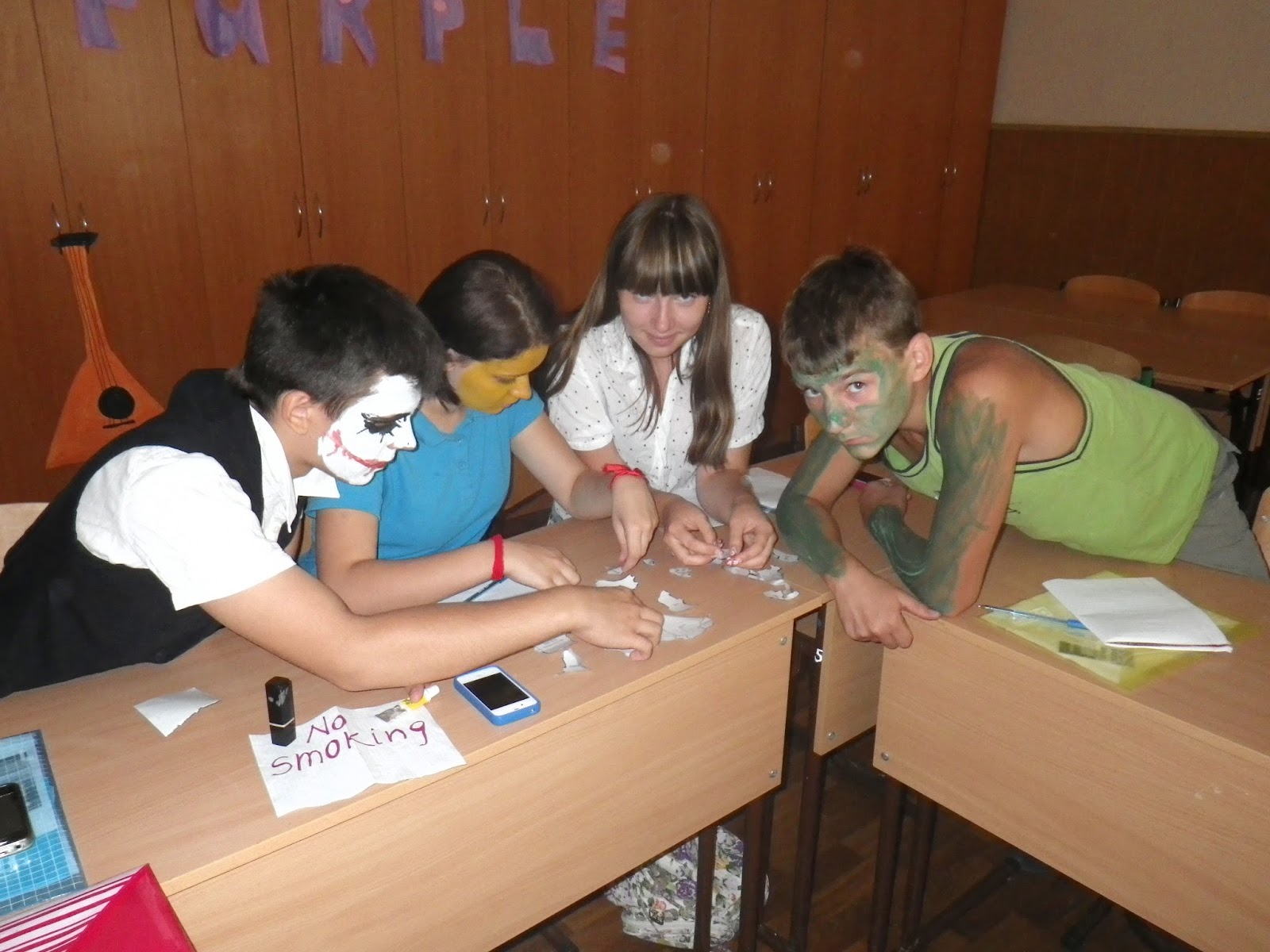
There were dress-up days:

America and Ukraine Day
Super Hero Day 
Dead Day
Twin Day
There was learning:

Still-life Painting
Geography
Human Anatomy
There were team challenges:

People to People!
Team name/poster/chant creation
A murder mystery
Field Day
And there was just wholesome fun:

Humiliation for Russian speaking
Dorm cooking night
Funky Chicken
Trivia night
Babushkas sticking out their tongues
Camp games
Card game night
A big thank you from all the staff and students to everyone who helped make this camp a home run! Your donations helped these kids have a wonderful 10 days that they won't soon forget.