Pages

Showing posts with label history. Show all posts

Wednesday, March 05, 2014

Evacuation

I know many of you have been following the situation in Ukraine, probably through the 24 hour hype-fest that is the American media circus. You will not find that here, nor will you find real journalism. You will, however, find one man's unaccredited view from the ground, as has always existed on this blog.

Start at the beginning? (If you don't care about the run up, skip down three paragraphs). Right after Thanksgiving of 2013, then President Viktor Yanukovich passed up an opportunity for closer economic ties with the EU in favour of strengthening relations with Russia. Among his detractors, this, for reasons unknown, was the last straw. Protests broke out on the main square in the capital Kiev, demanding that the EU deal be reconsidered. Yanukovich chose to ignore these protests. To his credit, I would have done the same in his position. The opposition leadership had little control over the demonstrations, demands were unclear, the weather was turning, and a series of important familial and religious holidays were fast approaching. No one expected this to last into 2014.

Then it did. The protest movement warped from one focused economic grievance into a broad revolution that would not be stopped until a change in leadership came to pass. This was about the time (latter January) when Yanukovich started suppressing demonstrations, protesters started capturing government buildings across the country, and the Western media began to pick up the story. We Peace Corps volunteers in Ukraine were placed under travel restrictions, and everyone watched to see what would happen next . Still, there was minimal violence, no looting, and all happenings were isolated to protest zones. Regular life seemed unaffected, especially in the traditionally pro-Russia and apathetic East where I live.

Then the fever broke. Yanukovich began to make concessions. Prisoners were released, laws repealed, and Independence Square quieted. Everyone in country breathed a sigh of relief, ploughing ahead with plans that would have been disrupted but now seemed in the clear. Unexpectedly, the situation erupted again, this time more violently. One minute, the opposition was pulling out of occupied state administration buildings, the next there was a death toll. Then roadblocks. Then the President fled.

I had a feeling that this time things were more serious. Violence had begun to spread outside of the capital and transportation was being disrupted. There were incidents of threats toward or injuries incurred by Americans. The opposition leadership seemed to be losing control of the momentum of their movement. The President's colleagues were abandoning the party by handfuls. All of these developments would be noticed by Peace Corps, and wouldn't be taken lightly. As a member of the security framework within Ukraine, I knew it was time to pack my bags and prepare for the worst.

On Thursday the 20th, we were told to congregate in our state capitals and await further instructions. Together with 14 other volunteers from my state, we holed up in two small apartments, baking cakes and listening to Chumbawumba to keep the mood light. Monday, at 3:30 in the morning, we boarded a bus for Donetsk airport. Most incidents of violence against Americans occur during the evacuation process, so everything had to be kept secret. We rolled past the Lugansk square, where 6 pro-government protesters stood wearing Balaclavas and brandishing wooden swords and shields, which I can only assume had been procured from a Soviet Renaissance Fair.

We flew to Istanbul and then to D.C., where a conference awaited us. It's hard to describe the feelings. It's a strange mix of reverse culture shock and survivor's guilt. No one was given a chance to process what was happening, to say their goodbyes, or to prepare for life and future in America. At the same time, it feels so completely selfish to complain about how "it's so hard in America because there are too many types of cheese and I'm used to just one" when in fact we did the easiest thing. We ran away from the country in which we had invested years of our lives in building relationships and fighting uphill battles, now when they seem to need us most. Why should we get yanked away when everyone we know is left behind?

There's still a considerable chance that Peace Corps will return to Ukraine, and I am not alone in holding on to that hope. Many of us are continuing to organise our summer camps, to plan projects and seminars with our partners overseas, to host English clubs via Skype, and to support Ukraine here in America through public presentations at schools and churches. I hope as I always have that Ukraine can find its common identity and a path forward with neither violence nor oppression. My heart goes out to the friends who comprise my Ukrainian family.

Wednesday, June 26, 2013

Cossacks

Map time! Here we have southern Russia, western Kazakhstan, the Caucus region, and eastern Ukraine, where I live. As you can see, my little green arrow is dead in the centre of the pale yellow shape. That shape indicates the territory most heavily populated by Cossack hordes.


These nomadic horsemen once thrived in the rich steppe and river basins of this region. The Cossack people have disputed origins, but they are likely a blend of Turkish, Mongol, and Slavic peoples and gained prominence around the 15th century. They were semi-autonomous and integral to the Russian border defence for hundreds of years. However, with the mechanization of the first and second World Wars, the Cossacks (and cavalries in general) became obsolete.

No longer instrumental to the protection of the Soviet Union, the Cossack subculture fell on hard times. During the Bolshevik period and the subsequent famine, the state redistributed many of the crops grown in this region among urban centres. As a result, the Cossack population dwindled.


In recent times, Ukraine, Georgia, and even Putin's government have taken measures to increase protection of what few Cossacks remain, now mostly poor farmers or peasants. In eastern Ukraine, however, people identify closely to the Cossack heritage and keep it alive as their own. Festivals celebrating the culture, conquests, and music of the Cossack people are frequent and spirited. More than half of the collectives performing in our House of Culture are dedicated entirely to maintaining and performing Cossack folk songs.

I often hear from volunteers in western Ukraine the misconceived notion that only in their regions can you find culture and history. While it may be true that Lugansk lacks synagogues, castles, or cities older than 200 years, ours was a nomadic and oral history and is not to be discredited. It may not be as photogenic as the West, but we do have loads of this: I give you Казачья молитва, the Cossack's Prayer.

Monday, August 01, 2011

Summer Vacation

In an effort to take a last spin around Korea and keep things cheap on the eve of a much larger trip, I used my summer vacation last week to scrape west along the southern coast of the peninsula. Busan, as usual, under-performed, but it did make for a nice springboard into Jeolla Province, a collection of largely farming communities and islands in the south west.


The first stop in Jeolla was the historical capital of the region: Gwangju. Unlike Gyeongju in the southeast, Gwangju's history is much more modern. Rather than the seat of the ancient government, these citizens boast the birth of the modern one. Although "democracy" in South Korea was established after the war in the 50's, it didn't really take root until the 80's. To spare you the boring details, after 2 decades of "presidency," Park gets assassinated and the military wipes out the interim government. General Chun becomes the new "president" of the "democracy" and on March 18th the people of Gwangju start demonstrating. The "communist rebellion" is violently put down however, and in what Koreans consider their own little Tienanmen Square, somewhere between 127 (government's claim) and 2000 (most extreme estimate) civilians were killed. Visiting the memorial grave site left me with both the awe of meeting a celebrity (for I had studied this event when I was at Yonsei) and the humility of being faced with sacrifice (especially for something Americans hold in such high regard).


Jeolla is known as the bread basket of Korea, and the food there doesn't disappoint. The highlight meals were the barley bibimbap (substituting steamed barley for plain white rice) and the massaged duck (massaged in sugar-vinegar-red sauce!), but everything right down to the barbecue or steamed pork was fantastic. The surprising thing was that it didn't rely on any "specialty foods" that couldn't be procured in Seoul, like Andong did. It wasn't even that the seasoning was more brilliant or complex. By and large, the stand out difference in the south west cuisine was freshness. Be it vegetables, rice, or meat, every ingredient tasted like it hadn't been packed up, cooled, preserved, or shipped, probably because it hadn't.


Compensating for the regions lack of vast cities, Jeolla's natural wonders were both breathtaking and expansive. I took the time to get up a mountain once I arrived in Mokpo, Jeolla's primary port. In contrast to the sprawling, tawny mess of spray-tan tourists that is Busan, Mokpo was the most quaint I've ever felt from a Korean town. A combination of the quiet atmosphere, the islands throughout the bay, and the wreath of mountains gave gave the effect either a hot version of Hokkaido or some Michigan lake town that was miraculously also in Appalachia. As wikitravel could tell you, there's not much to do here beside eat ray or leave, but somehow you don't care. Scaling Yudal mountain in the late Friday morning heat was not exactly agreeable, but it turned out to be one of the few times I've gotten a sense of gratification from a climb. For me, altitude doesn't add much to nature, but peering out into what looked like a mountain range sprouting from the ocean was terribly impressive.

Tuesday, February 01, 2011

Never Leaves the Gates

Not long ago I spent a weekend in Andong. Andong is geographically on the southeastern quarter of the peninsula, yet not so far as to be coastal. As with much of this country, it is flanked on all sides by a battalion of mountains. Right through the heart of the city runs a major river that has been dammed up to create Andong lake. Culturally, the city is home to many superlatives, including the oldest standing wooden structure, the first stone pagoda, the strongest alcohol, the original masks of the Koryeo dynasty, the longest foot bridge, the most authentic folk village, and the largest statue of Buddha.

The most important superlative for my particular trip was neither geographical nor cultural: it was meteorological. I unwittingly chose the coldest day of the year in Korea to visit a city where the only things to do are be outside and eat. That doesn't mean my group and I wouldn't put on a scarf, an extra pair of socks, and a happy face in spite of it all.

The first place we stopped was accidentally the original bakery of Korea. Mammoth is reportedly the bakery upon which all the other chains in the country have been based (Tous les Jours, Paris Bagguette, etc.). It was certainly a cut above the rest. I had a legitimate croissant for the first time in 2 years. After the bakery, we scoped some of the food and markets, then began walking out toward the pagoda.

On our way we stopped at the largest operating temple I've ever witnessed, just to avoid the weather for a few minutes. We took off our shoes and crept around in the ornate worship hall, trying not to disturb the one praying woman along the south wall. After we'd warmed up our feet and worn out our welcome, we trekked further east out of the town until we came upon the 7 story pagoda. It wasn't much to look at in comparison to some of the more decorative ones in Seoul or Gwangju. However, it was a treat to see the rudimentary early attempts at a structure that has become so prevalent in the region.


We next crossed the river southward over the longest footbridge in Korea.  Of course, it's kind of a cheap achievement in that they designed the bridge to unnecessarily zig-zag its way across, but it's an achievement nonetheless.  On the other side waited a smaller and unused folk village that was preserved from when the dam flooded the plains in the seventies.  Unfortunately, it was so painfully cold that my face was getting windburn, so we ducked into a small museum.  I spent a half an hour following a young family, using the mother's watered down explanations that were meant for 5-year-old ears as my audio tour.

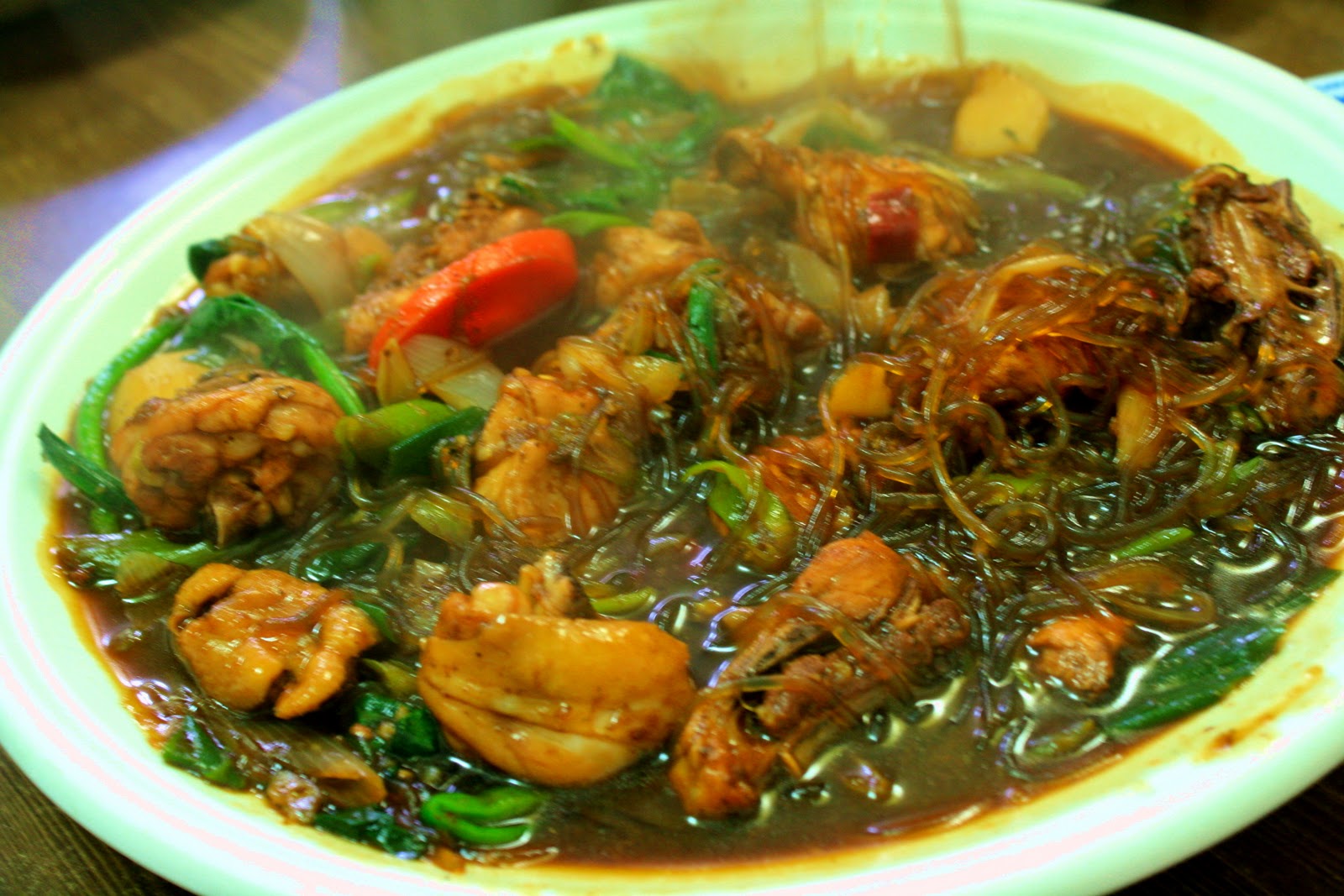
After cabbing our way back into the city proper, we sought out Andong's arguably most celebrated cultural property: andong jjimdalk. This is like a bona fide stew, just with chicken rather than roast. Big discs of potato and carrot give it that hearty, home-cooked feel. The stew part itself gets reduced down to a thick, soy-based gravy, and it's kicked up a notch with the addition of red pepper. All this is heaped onto a bed of vermicelli noodles. The chicken really takes a back seat when it's all said and done.


There's no need to go into detail, but the legendary 40% alcohol content soju of Andong (which is rumored to not have been allowed outside of the city's walls) got the lion's share of the rest of the evening. In the grog of Sunday morning, the group rehashed what was yet to be done before heading back up into Seoul for another week of grind. It was clear that Hahoe needed to be seen.

Hahoe is the largest folk village in Korea out of which people still live their daily lives. Just a few kilometers west of Andong city center, it consists of several dozen houses, a ferry, restaurants, and a museum. Before we wandered through the village, we stopped for lunch. The menu: "phantom religious service rice." This is a horrible translation for a delicious appropriation of ceremonial food to everyday life. In the past, this food was part of ceremonies which were held to remember and respect lost loved ones. Nowadays, this spread of grilled fish, salted mackerel, piles of side dishes, and a local variation on bibimbap is less about veneration of one's ancestors and more about keeping those who've survived them full and happy. My stomach is okay with that.


We left the would be funereal commemoration and wandered into Hahoe village proper. It was not structurally much different from anything else I'd seen. The life of the place was what made it interesting. Something that's usually an outdoor exhibit was alive and operating. Vegetables hung drying along the typically barren walls of the homes, and wooden chairs sat in what I'd only known until then to be dust lawns. Here there was not only grass, but trees, garden stone paths, and even residence numbers for the postman.

One of the last things we experienced on the way back toward the bus station was the mask museum. Apart from hundreds of international masks, it houses 9 of the 12 original wooden masks that proliferate the touristy areas of Seoul. One of these is missing its jaw piece. The story goes that the man who was commissioned to carve these masks in the first place was told to do so under conditions of the utmost secrecy. Obediently, he wrapped his house in paper and sequestered himself for the duration of his task. Unable to control her curiosity, a young girl from town poked a hole in the paper with her finger and took a peek. Although he was on the 12th masks mouthpiece, he hadn't finished the task yet, and as the girl peered into the room the carver promptly died. 4 of these originals have been lost or damaged over the centuries, but 75% of the history remains there in Andong.

The question that persisted through the weekend: Are you Andong? Final decision is yes. I could eat jjimdalk on the regular. I was impressed with the concentrated history. I want to see the various folk festivals of the summer. I enjoy being ensconced in mountains. I felt at ease in the laid back environment of both its people and its foreigner community. I am totally Andong.

Wednesday, January 12, 2011

Taipei Completed

The last full day of Taiwan started with a bus trip to the extreme northern tip of the island.  Unlike anything we'd seen so far, the harbor town of Wanli was clustered like a city but small and cozy like something near a mountain and the coast simultaneously should be.  The shops and restaurants spilled out right up against the road on which the boats were moored.  The reason that we came out to this little town was to see the Yehliu Geo Park.  All we had to do was grab a handful of dried squid that tasted like spicy raisins.


I've read Yehliu park described as "walking on the moon." With the bright orange landscape, it was probably more akin to walking on Mars, but then again water was so vividly present.  All the excitement takes place on a small cape, not much longer than a 200 yards from the town to the Pacific.  Every part of this stretch was a geographical freak show.  Be it wind or water, plate tectonics, biological residue from long-dead plankton, or even the densities of the various rock itself, nature and time had worked strange miracles on the whole area.  One of the most prominent features was the strange protruding polyps that jutted up about waist high, each covered with an eccentric honeycomb of pockets and supported by tapering bases.  The ground itself was either its own series of water-filled divots or  Neapolitan ribbons of different rock swirling underfoot.


Aside from the pod-like protrusions, the Mars floor, and the occasional cave, the other key feature were the precarious rock towers.  None of them were much more than 8 or 9 feet tall, but they felt delicate on account of the crackled surfaces.  It is one of these exact towers that has attracted so much interest to this tiny cape off of a tiny town on a tiny island.  There is one tower that unarguably resembles the profile a very stately and proud old woman with some sort of extreme bun.  "The Queen's Head" has become a symbol of not only the town but the entire country, and was therefore appropriately touristy.  A path had been lain that swooped right past this geological curiosity and as-much-of-a-line-as-Asians-can-form had formed.  Josh managed to capture the grumpy old Taiwanese man who had stubbornly held up the line so he could waddle back and forth for the perfect position (much to the acrimony of the Korean family immediately behind him) and then his granddaughter could not understand cameras (more Korean ire ensues).


Of course I had to take the same photo myself.  I mean, who knows when that girl's going to collapse?  It's a miracle Fanapi didn't do her in.


On our way back into Wanli and subsequently the bus stop, we had to stop at one of the multitude of fresh fish restaurants for some sushi and squid.  We got decisively out-eaten by the nearby table of four, who had covered their Lazy Susan with five dishes.  Not too shameful, until on our way out we noticed two more platefuls headed over to the very same table of 4' tall stomachs with legs.


After the terrifying bus ride back to Taipei (as with most countries that aren't Japan, bus drivers floor it on mountain turns like they have IBS and it's trouble time), we made our way out to the port on the north-west edge of the city in a district known as Danshui.  The streets here boasted European store fronts and Victorian lamp posts, thanks mostly to one missionary whose name eludes me.  Aside from the atmosphere, this area is renowned for its oceanscape sunsets, which did not disappoint.  Not really the sappy type, but I just stared at this postcard scene until the last color left the sky.  It was to surreal to have been from a movie.  Rather, it was the type of sunset you'd imagine Chroma conducting in Phantom Tollbooth.


Surprisingly, by the end of this day we had both had our fill of Taiwan.  Opting for Thai food rather than local cuisine and eager to get home the following afternoon.  We pondered over green and coconut curries why the vacation had left us yearning for bibimbap.  Was it the exhaustion of non-stop walking?  The mild indigestion at the smell of wheel barrels filled with organ meats?  The frustration of being constantly in a city where we can't communicate or even sound out words?  Whatever the reason, we both agreed that the familiar sights and flavors of Seoul would  be a more than welcome comfort.

The trip wasn't quite over yet though.  We still hadn't climbed the towering Taipei 101.  It was as expected: tall.  More exciting than the prospect of standing atop the 2nd tallest building in the world was the ride to the top.  The elevator was equipped with airplane-style artificial atmosphere technology, since the ascent was too rapid to be bearable without cabin pressurization.  The shut down all the lights in the rocket-coffin except for twinkling constellations on the ceiling, presumably to keep you from panicking over a loss of power.  There was an eerie space music akin to the iPhone ringtone.

The other thing that was architecturally intriguing about this building was the "tuned mass damper sphere," a humongous pendulum of sorts housed inside one of the topmost floors.  I learned that this technology is commonplace in skyscrapers that are built in areas which experience earthquakes.  What I didn't learn was the physics behind how this 4-story tall steel sphere (the largest of its kind in the world) shakes instead of the building which stands around it.

The last stop before our plane departed was the Sun Yat-sen Memorial Hall.  Commemorating one of the "founding fathers" of Taiwan, it is one of the most recognizable buildings in the city.  One of Chiang Kai-shek's right hand men, the statue of Dr. Sun leaves a very Asian-Lincoln Memorial impression


Taiwan left me with some beautiful natural memories and a permanent quest for Taipei bubble tea, but there's no substitute for comfort. Sadly it's taken me so long to finish the account of this trip that I've already come and gone on another. Next up: Vladivostok in late February. However, before I can romp around east coast Russia, I'll be back stateside for 12 days in early February. If there's anything you want from Korea, now's the time to ask!

Monday, December 27, 2010

December 26th, 2010

PhotobucketI'm back at the hostel, and what a day it has been.  I started off early at the train station to meet DW.  Unfortunately, it was the wrong station.  After about a half an hour of waiting for him to arrive, I decided to borrow a phone and call.  Another first: total rejection on the phone borrowing.  The girl didn't even say, "Oh, sorry.  I don't have one..."  She just gave me a blank stare and then made an 'X' with her arms.

Luckily, pay phones are super cheap.  This one cost a penny for 30 seconds, which is plenty of time to locate DW and coordinate our meeting.  We're soon together and on our way to food.  First up on the menu?  Noodles.  We keep it simple with two Japanese classics: udon, the thick noodles that came with okonomiyaki yesterday, and soba, a thinner buckwheat-based noodles.  Both were satisfying and delicious, especially for the price.


Photobucket


Photobucket We head out from there to witness some unique architecture.  The iconic building of Osaka, the Umeda Sky Building, is essentially a pair of office buildings that are connected at the top by a glass doughnut.  Several escalator columns and hallways also span the abyss between the two towers.  Everything inside is decked out with couple sofas and photo opportunities.  In Asia, Christmas and Valentine's Day are virtually indistinguishable.

Photobucket Our next goal is to see the palace of Osaka, but not before eating again.  We stop in for one of my old favorites called kaitenzushi, or sushi by conveyor belt.  This sushi bar is set up kind of like a capital 'B,' with the sushi chefs sitting inside of the letter, the customers positioned around the arcs, and the kitchen along the straight edge.  Tracing the entire "letter" is a miniature conveyor belt crammed full of sushi plates.  All you have to do is grab the plate that you want to eat, then wait until another delicious looking fish passes you.  All the chefs have to do is see what's missing on the conveyor belt and just keep things stocked.  No ordering, no waiting.  A culinary first: fatty yellowtail.

Photobucket


Before we make it to the palace (maybe we got lost and walked several blocks out of our way...thank goodness Japan has maps on every street corner), we again stop for food.  This time it's takoyaki.  These warm dough balls have a small piece of octopus in every bite, and a lot of sauce to boot.  Though it's available throughout Japan and even in parts of Korea, it is quite highly regarded in Osaka and for good reason.

Photobucket


The palace was finally within our grasp but the sudden rain deterred us.  We chose rather to duck into the museum of Osaka history.  There we learned that there are several different grind patterns that can be used when sharpening a katana blade, and that the majority of buildings in the city that are older than 100 years have either been burnt or shaken to the ground at least once.

Photobucket


By the time we've finished in the museum the rain has subsided.  On its exterior, gilded dragons and tiger guard its walls.  It's multiple roofs jut out impressively, adorned with brightly gilded fish.  It is perched in a garden on top of a high stone wall which towers like a man-made mountain above a murky moat.  Its gates are ominous and hewn from a wood that is near black either by nature or age.  Though distinctly Japanese, it feels as impenetrable as any good castle should.

Our first impressions of the interior are much less grand, however.  The entire castle has been gutted to make room for a sort of museum, but it is lackluster.  Then we hit the jackpot: a collection of traditional samurai armor.  The face plates were gruesome and foreboding.  The helmets were frequently crowned with stag beetle tusks or golden antlers.  My personal favorite was the black helm whose back had been affixed with long metal sunbeams that splayed out radially like some cross between a peacock's eminence and a scorpion's menace.  Pictures were strictly forbidden.

Photobucket The day was capped with you guessed it, more food.  My last Osakan meal consisted of another sampling of takoyaki, a plate of chicken karage, and miso ramen.  Unlike other Japanese ramen I've had, this broth was incredibly thick.  It was as if rather than thickening water they instead opted to thin peanut butter.

I close Christmas weekend with a final pre-dawn trip to the airport.  Incheon International Airport welcomes me with yet another frightening airplane moment.  I hadn't noticed that we had exited the cloud line because everything beneath it, including the ground itself, was the exact same white out.  While I was away Korea had properly entered winter.  Touching ground was a startling turn of events, as until the turbines had begun to blown away the powder there had been no way to see that ground even existed.  I wondered whether or not there was even enough friction between our tires and the pavement for us to reach a full stop in what had over a weekend transformed into Fargo International.


Now I'm on my way back home, where language is mine and comfort abounds.  With any luck, I'll be able to snag a quick shower before I have to start teaching again.  This trip has made Japan my single most frequently visited country, at three times.  A big thanks to DW for making the four hour hike on the 4:30 train from Tokyo just to meet me for a day.  It really made my Christmas wonderful, despite the exhaustion and unfamiliarity of travel and new cities.

Sunday, December 12, 2010

Jeonju

Experiential value is one of the primary reasons I am living here, and lately I've been lacking in local experiences.  Yesterday, I decided to change that.  Catching the first subway to the express bus terminal and then the next bus available, I and three of my friends made the way to the renowned southern city of Jeonju.

If you zoom in, you can see the contrast of the traditional roofing to the rest of the city scape.


Since it was only a day trip but the bus ride takes 2 hours, we had to limit our goals while in Jeonju.

  1. Eat bibimbap, the dish of fresh veggies and rice stirred together with red pepper sauce, until we find the one style that makes this city so famous,
  2. Explore the traditional  HanOk Village, which is the largest zone of the country where people still live exactly as they did hundreds of years ago, and
  3. Enjoy some of the towns famous makolri, an alcoholic rice beverage.

The first place we explored after getting off the bus was HanOk village.  While it had the appearances of a traditional village, it didn't have the feeling.  The buildings looked right.  The roads were cobblestone.  The palace was like the rest.  Unfortunately, besides the architecture, the rest felt strikingly modern.  There were coffee shops, street vendors with bad knickknacks, and swanky restaurants.

The highlight of the village was the palace, where we inadvertently became a member of yet another children's field trip.  The tour guide was exceptionally welcoming, and made sure that we understood his explanations of some of the architectural features of the palace.  He also made all the children greet and bow to us.
On the edge

Before and after this village roaming, we ate bibimbap.  Prior to coming, We had heard two different rumors.  One was from fellow westerner and Korean blogger hiddentreasures.  Every time we ate bibimbap in Seoul, she reminded me that it just doesn't compare with Jeonju.  This city was legendary for having the "stir rice" to end all "stir rices."  The other rumor was from my 6th grade students, who claimed that there was nothing special to be had in Jeonju.

We first tried a back alley, local looking place.  It was sandwiched between two other clearly non-tourist restaurants and across from an elementary school, on a street that featured no other bibimbap at all.  The prices at this restaurant were absurdly cheap, the ingredients were fresh, the stew that came with was above and beyond, but the bibimbap itself was quite bland.
Not to say it didn't look delicious.

 Our second attempt, after the roaming, was at a tourist restaurant.  We figured maybe swankier was tastier.  While this one was high-quality, with such delightful features as raw steak, it was not the bibimbap to end all bibimbaps.

We decided that maybe it was best we left it that way.  While it's a bit disappointing to go to the city of bibimbap and not have the best I'll ever get, it's perhaps more disappointing to spoil an entire dish for the rest of my life.

We moved on to our third goal, the makolri.  The most notable difference between this and other rice liquors, like sake or soju, is the filtration.  Most rice-based alcohols come clear, like vodka.  Makolri, on the other hand, does not have the ground rice filtered out during the fermentation, leaving it opaque and chalky.  Think beige Pepto Bismol.  While it may take a bowl or two (it is drank from what look like rice bowls) to get used to, it grows on you.

Here, things went much as we expected they would.  The price was comparable, the flavor was identical.  There were two massive differences, though.  The first was that the makolri itself was clear, like a pale apple juice.  This was quite surprising, as the taxi driver assured us that it would not be any different than what we could find in Seoul.

The second and most satisfying surprise was that one order of makolri came complete with a spread of food.  Everything from stews to fresh fruit, boiled eggs to fried ones, clams to sweet potatoes, oysters to acorn jelly. This offset the price of the drink itself to practically free.


In the end, though neither the bibimbap nor the traditional village blew our minds, we counted the day a success.  We thoroughly enjoyed the new scenery, the adventure, and the company.

Thursday, September 23, 2010

Tourism Time

With the combination of friends in town and new teachers to break in, I've had the chance to be a tourist in my own city again this past month. Most notably, this has manifested as a trip to the zoo and one to the War Memorial.

There are some weird things about an Asian zoo, but not many. I did feel a little too close to the animals, but never in an unsafe way. The exhibit of the Americas made me feel a little strange. The exoticism of what seems so ordinary in America puts into perspective just how far away I actually am. However, after multiple cages of wild dogs I can't take your zoo seriously anymore. Coyotes? Not zoo worthy. Racoons and possums? I've hit more with my car than your zoo can afford to import.


The War Memorial is a museum that I've always intended to go to but never gotten around to it. Although it contains them most comprehensive exhibit on the Korean War, it is situated near the army base in Itaewon rather than near the DMZ itself. Probably the most interesting feature was the extensive collection of air, land, and sea vehicles on the lawn, not to mention missiles and other large weapons. Both the outside and the inside of the building were adorned with various commemorative statues. There are two open-air wings of the museum dedicated strictly to the names of the countless soldiers who served during the war. The museum also goes to great lengths to recognize each and every one of the countries who helped secure South Korean independence, complete with videos of each nation's specific contributions to the cause. More than just a recount of the important battles, it was a very somber place, truly earning it the title of War Memorial.