Pages

Showing posts with label culture. Show all posts

Wednesday, March 12, 2014

Superstitions

A source of constant surprise, frustration, and amusement, I encountered numerous superstitions while living in Lutugino. Whether these are uniquely Ukrainian or held over from Soviet times, I can not say. Most people will admit that the majority of these are ludicrous, but they've been hammered with these beliefs since childhood and they are now behavioural norms. There are several overlaps with the rest of Europe and with America, such as the black cat, salt spilling, and "knock on wood" tradition. Here are the ones which I've noticed over the course of 2 years:

Rule:
You mustn't whistle indoors.
Repercussion:
You will not have money (this is a common consequence).

Rule:
You mustn't walk through any triangles (not only under a ladder).
Repercussion:
You will contract an illness (another super common one).

Rule:
You mustn't step on manhole covers.
Repercussion:
You will contract an illness. (This one originated from the fact that covers are often loose or stolen, so it's better to just be in the habit of avoiding them. For your health.)

Rule:
You mustn't tear (e.g. a thread or tag), cut, or sew any clothing that you're wearing.
Repercussion:
You will contract an illness.

Rule:
You mustn't sit at the corner of a table.
Repercussion:
You'll never get married.

Rule:
You mustn't count money or pay someone after dark.
Repercussion:
You will not have money.

Rule:
If you have a slice of bread, you must finish it.
Repercussion:
You will not have money.

Rule:
You mustn't take out the trash or throw things out after dark.
Repercussion:
You will not have money.

Rule:
You mustn't pass money from hand to hand, but instead lay it on a surface (traditionally a wooden one, but that's become rather flexible).
Repercussion:
The passer will not have money.

Rule:
You mustn't cut your hair while pregnant, nor cut the child's hair within the first year.
Repercussion:
The child will be unhealthy.

Not to make it seem as though it's all doom, gloom, illness, and poverty, there are also some situations that will bring one good luck and riches:
  1. A spider descends from your ceiling and lands on your head.
  2. A swallow or a stork builds a nest on your roof or balcony.
  3. You allow your pet to enter your new home before you start moving in.
I know there are also myriad examples of wedding superstitions with which I'm simply unacquainted, and I've already written about Ukraine's borderline mystic health beliefs. If you know of any Slavic superstitions that I've overlooked or you've encountered any weird ones in your travels abroad, I'd love to hear about them. Comment below!

Thursday, January 02, 2014

New Year's Party

Growing up, there were no vegetarians in my family. Food was never a moral choice. None of us were trying to make a wrestling weight class or hike the AT, so it wasn't about calories per dollar. We weren't looking for speed or convenience, but weren't overly bougie about the dinner table.

So, yeah, not this.
For us, meals were about sharing, showing love, enjoying time together over a spread of the mouth-watering and comfort-imparting. It is in that spirit that I prepared my home for NYE14, both the most important Ukrainian holiday and the last one that I'll spend here. Did I want everything to be photo-worthy? Obviously. Did I want to bask in my favourite phrase all night (Стивен вообще молодец.)? Shamelessly. Most importantly, though, I wanted to pour love all over these awesome people, because this time next year I will have been long gone.

Any Ukrainian gathering needs three things for success: copious amounts of food and alcohol, places for taking pictures of yourselves, and activities. Obviously, the first I had in spades. Goose slow roasted for 4 hours, basted with pomegranate juice every 30 minutes,


Thai coconut shrimp with sweet and sour sauce (and sesame shrimp, due to a brevity of coconut shavings),


and an American pasta salad (something Ukrainians would apparently never dream of, although it makes so much sense for their palate.) are just a few of the dishes on our New Year's table. 


In fact, all the food couldn't fit on the table at once, so the finger foods had to make their home off in the kitchen.

The rest of the night is was just joyful. We played some games, we took some pictures, we recorded video of ourselves and what we wished for the group in the coming year. In Ukrainian tradition, we wrote our wishes on slips of paper, burned them at midnight, then drank the ashes in champagne. There was karaoke and Twister. There were no fist fights (so proud of you, Ukraine). Certainly it was a night to remember. Next year, wherever I may be for NYE, I'll be thinking of these awesome people and the time we spent together. I hope they'll be thinking of me, too.


Wednesday, October 23, 2013

Defence

Government funding here is not, as you might expect, doled out evenly regardless of merit and without incentive for improvement. Government employees, let's use teachers as an example, are asked to "defend" their skills every 5 years. If a teacher can prove that they are implementing modern methodological methods, improving students' abilities, and successfully imparting the required national curriculum, they receive a raise. If not, they are stuck at entry level pay for another 5 years. This process is called "defence," and it entails a lot of preparation, stress, and observation by important officials from the capital.

Just as teachers' pay is determined by these demonstrations of success and improvement, so is the House of Culture's funding. Any HoC receives a base budget from their local administration, in our case the Lutuginsky Region. However, if a HoC has dance, theatrical, or musical groups that are performing at a particularly high level, those groups can earn the status of "National." This means that the local administration's base budget is supplemented by a federal bump. This is rewarded since, aside from encouraging excellence, it is also assumed that excellent groups will need better costumes, transportation to festivals, and registration fees for competitions. The more National groups a HoC has, the more its overall funding.


Okolitsa (The Outskirts) defended its National status last Monday. Given that we are a "Cossack Folklore" group, we not only had to build a vocal repertoire, but also weave it into a skit that demonstrated traditions, told popular stories, and showed dance styles. We even prepared a spread of Cossack foods for the judges (which seemed ever so slightly like bribery).

Our local newspaper Glorious Labour, quoting the Director of the Lugansk Oblast Centre of National Arts, Honoured Employee of the Ukrainian Department of Culture, and Representative of the Certification Commission Vasily Yarovoy:
Today you have demonstrated the traditions of Ukrainian musical art, and what I've seen today has simply touched my soul. Yourperformance had wonderful voices, it had the beautiful spirit of giving, a high level of mastery and just a shocking atmosphere....It had soul, and that's all from you. Thank you for bringing our culture - Russian, Ukrainian, Don Basin Cossack - to the people. I'm proud that I myself have the opportunity to congratulate you. Such a young group, which means you are going to go places. Best of luck! Be creative!
 The result: we succeeded in defending our National title.


You can find more from the Okolitsa defence performance here.

Monday, October 07, 2013

Ukrainian Comic Con

Ok, maybe not. More like an exhibition of Soviet comic artists and authors. But still, I've been looking for this sort of thing throughout my 19 months in Ukraine; the art scene, the counter-culture, Spiderman in Russian, locals who look more like Tank Girl than receptionist Barbie.


The event was held at the ArtPRICHAL gallery in Kiev, a nifty little art space wedged in under a bridge along the Dnepr river. The front of the room consisted of a few tables where vendors were selling comics and graphic novels, mostly by American authors, both in English and Russian. The back of the space was set up for lectures about a variety of topics, including art techniques, new technologies, and breaking into the industry. One of those new technologies was being featured at a small station in the centre of the room: a digital pad that registers a stylus and renders its strokes onto a computer screen.


Lining the walls of the whole gallery, poster-sized reproductions of comic book pages were hung. For me, this was the main attraction. All of these comics were written and drawn by ex-Soviet authors and artists. It was enthralling to see what kind of graphic art is coming out of this region, all of it burgeoning and creative. Not surprisingly, very little of it was influenced by the DC/Marvel giants in the American industry. There was rather a strong connection between Asian manga and this art style, though not exclusively. Some pages were reminiscent of Shel Silverstein, some of Tim Burton, while still others were akin to webcomics such as Penny Arcade.

Without any further blathering, some of the pieces that I found interesting:

History of a samurai
"Harikiri!"
The End.
"I am not a cat!"
Several panels from the textless comic "The Red Thread," which reminded me of Harold and the Purple Crayon.
"The Forgotten," another textless story about a monkey and his dog, abandoned in space, and how the come home.
One of the really fun things about reading comics in Russian is seeing how they put sound into text. "SKREEEEEEE TOOD!" (a squeeky hinge and then a door slam)
4 from a whole Farside-esque series of mini-comics in a book named simply "Ostrich." Basically, what happens in different situations when a timorous ostrich sticks its head underground.
For anyone living in the region (or anyone simply interested in some Russian comics) there is a big online vendor called On The Bus. This time next year, they should have a location open in Kiev as well. For anyone who has ever looked, you know that it's impossible to find comics in book stores here. If you're language learning, it is helpful to read something with pictures that also doesn't treat you like a 5 year old. Not only that, but there's lots of fun slang and colloquialisms. I'll be working through some X-Men this winter, and hopefully I will be able to give villainous monologues and witty one-liners in time for my close of service language test!

Friday, August 30, 2013

Розкололось серце на дві половини.

In the past month I've taught at a seminar in the capital for teachers and volunteers, and I've also begun working on a section of a team-teaching manual for all teachers in Ukraine. However, most excitingly I've joined a group of Cossack singers. They sing songs native to the Zaporozhian region of the country (the most westerly river on this map), so everything we sing is in an archaic Ukrainian dialect (yuck), but the music is very beautiful and surprisingly eastern influenced. Here's one of the songs we're working on currently, and as soon as there's video of me in full Cossack garb belting bass and shaking tambourine, I'll be sure to post it.


Edit: As promised, here's a group shot of our folk group "The Outskirts." Let's play "Guess Who's American!"


Saturday, July 06, 2013

Health Concerns

To an American, lots of countries approach medicine and health in ways that seem...well, foreign. Koreans believed that if you left a fan running overnight without opening the windows, the closed circulation would literally kill you. Eating dog soup was considered holistic Viagra. In major hospitals, open containers of blood and urine samples would sit next to each other, but sitting on a desk was dirty.

I'm only able to speak with any authority on Korea's idiosyncrasies because of the extended time I've spent there. Just passing through a country isn't enough to unearth these traits. More time is required before the peculiarities of health beliefs present themselves. After 15 months in Ukraine, I've been educated in some of the unexpected effects on my health that I would never have expected. Here are 8 things Ukrainians wig out about.

Sitting
Seemingly harmless, sitting can lead to serious consequences. A Ukrainian would never be caught sitting on the ground or on any concrete for that matter. This stems from the belief that such cold surfaces will render you infertile. Interestingly, neither the season nor your gender seem to be a factor. Ancient and unfamiliar women have no qualms about admonishing you for breaking this tenet.

Cold Water
As with most other countries, it's difficult to find liquids at a sufficiently cold temperature. Ice is a luxury, and in the summer even grocery store refrigerators may be used as simple shelf space to conserve electricity. I've heard echoes of the same widespread belief that cold water hinders digestion, but that's not its most interesting health property. Ukrainians believe that ice water is an immune system booster. One of my neighbours pours a bucket of cold water over himself every evening, and he's not alone. On the cover of our school's health text book is a man doing just that. The permeation of this belief was best seen during the Epiphany ceremony in January, when several dozen townsfolk baptised themselves in our frozen lake. Even those who eschewed the privilege averred that no one could possibly get sick after such a plunge.

Wind
Anyone who has taken public transport in this country can attest to the aggravation this health concern causes. I say wind, but the Russian word is separate from typical wind, being more correctly translated draft. Whereas Koreans believe that the closed windows will kill you, Ukrainians believe the exact opposite. When I first moved in to my apartment, the men who were helping me were reluctant to place the bed under the window. Small cracks in the window will let in drafts, which would kill me. Numerous times on buses or trains I've opened windows, only to be barked at by someone behind me. There are children and the elderly on this bus! Are you trying to kill someone!

Chalk
It's a common occurrence in Ukraine to brush against a wall in a stairwell or public building and later find that your whole shoulder is dusty and white. Until several months ago, I believed Ukraine was using chalk as a cheap alternative to paint. Only recently was I corrected. It hadn't dawned on me that the cheapest alternative to paint is nothing. So why rub chalk on all the walls? Locals tell me that this coat of chalk acts as an antibacterial. I think it begs the question: why have we got bacteria all over our concrete walls?

The Common Cold
Three things that I love to ask people from other countries: what do you put on pizza, what do you do to fight hangovers, and what is your cure for the common cold? Well, in Ukraine we add ketchup and mayonnaise, we drink cognac to beat the headache, and if you feel a head cold coming on you need, you guessed it, vodka. Not just any vodka, however. Ukrainians drink a hot pepper and honey infused vodka, slightly warm or at least at room temperature, chased with a lemon slice, followed by a good sweat. This is usually induced by immediately burying yourself in all the blankets in the house.

Hats
This is another touchy subject for the grandmother police force that patrols the town. Your hat must appropriately reflect the weather conditions and is, naturally, their business. Warm winter hats are a must if you don't want every person in town to inquire as to its whereabouts. What I find really interesting is this: the hat doesn't have to cover the ears. Covering up my ears was always one of my mother's winter bundling priorities, yet here it needs only to be on top of the head. Leaving the house without a hat in winter is a recipe for your death of cold, and it is every woman's job to prevent you from coming to such an end. Don't make the mistake, however, of wearing an even partially winter hat into the warmer months: that will kill you, too.

18:00
Something mystic and esoteric occurs at six in the evening. Common dieting wisdom in Ukraine tells us that anything consumed after six will become fat, regardless of what you do in the evening or how late you stay up. For whatever reason, lots of women in my town believe and follow this commandment: после 18:00 не жрать (After 6, don't scarf). In fact, I've seen it more then once as a refrigerator magnet, warning off would-be late night snackers.

Jogging
This applies to most aerobic exercise that isn't folded in to sports like soccer or basketball. Ukrainians can not comprehend why we exercise using transportation. Running is for going places, but you don't go anywhere. You just go in circles. It can't be good for your heart to move so fast. I have actually heard people tell me this. Lots of other volunteers jog around their towns, and they will support me in this. The staring is ubiquitous and consistent. I guess no one explains to them that the accelerated heart rate is exactly what causes the weight loss, or perhaps Ukrainians simply don't support detaching the process (sport) and the goal (exercise).

I'm always interested in uncovering new oddities about this and other countries. If you're reading from Ukraine or any other foreign country and have another strange health story you'd like to share, leave me a comment! I'd love to read about it. 

Monday, July 01, 2013

Kulesh


Kулеш (pronounced cool-YESH) is a camp fire soup. It originated as an army food of the Cossacks in Zaporozhye, but has since spread to camp sites everywhere. It's simple, cheap, and comforting, much like chicken noodle soup. Let's learn how to make it together. A Ukrainian will tell you that it is mandatory to make this soup over a fire, but honestly there's no reason why you can't make this on the range. Well, maybe there's one reason, but it's not a deal breaker. We'll come back to that in a minute.

Starting at the beginning, you'll need:

  • 1.5 kg Russet potatoes
  • 500 g cooked meat (Feel free to use any sort of leftovers you have around the kitchen. We used pulled pork, but chicken is also very popular.)
  • 1 onion
  • 1 carrot
  • 200 g millet
  • 3 bay leaves
  • salt/pepper
  • 1 cup greens (parsley, dill, green onion)
To hang the cauldron, Sergey cut some green branches, two with forks in them to be pounded into the ground and one a bit sturdier from which the pot could reliably hang. That metal wall was set up to protect the fire from the wind. We got the fire up, then started to boil the water. The onion goes in peeled but otherwise inatact. The bay leaves should be added as well.


Once the water is rolling, it's time for the potatoes. They should be peeled and cut into small cubes.


When the potatoes are done, It's time for carrots, cut julienne, and millet. If you are like me and have no clue what millet is, you could use a comparable grain like barley or even oatmeal. If you do know what millet is, good for you, but you're probably one of those gluten-free loonies, so bad for you. If you live in Ukraine and want to find millet, ask at your rinok for пшено (ударение на втором слог).


When the millet is soft, add the meat and greens. Boil for 5 more minutes and then serve. It's that simple. We actually used this seemingly disgusting boiled-pulled-pork-in-a-jar product. It's not as bad as it sounds. Or looks.


The only reason this must be done on an open flame, other than tradition of course, is the final step. Sergey took another green branch, peeled the bark off it, and then put the raw wood in the fire. Once the wood was blackened, He actually stirred the soup with the charred branch. It didn't make everything taste like cigarettes, as I expected it would. It just added the illusion that we had grilled the meat. Therefore, if you actually grilled the meat that you used, I think you could approximate the smokiness fairly well.


So, that's kulesh! Of course there are lots of variations. One of the more popular ones involves less water and a few beaten eggs at the end, yielding porridgy results similar to Korean juk. We, however, just stuck with the original, and it was both fun to make and filling to eat. I hope you guys enjoy it as much as we did!

Wednesday, June 26, 2013

Cossacks

Map time! Here we have southern Russia, western Kazakhstan, the Caucus region, and eastern Ukraine, where I live. As you can see, my little green arrow is dead in the centre of the pale yellow shape. That shape indicates the territory most heavily populated by Cossack hordes.


These nomadic horsemen once thrived in the rich steppe and river basins of this region. The Cossack people have disputed origins, but they are likely a blend of Turkish, Mongol, and Slavic peoples and gained prominence around the 15th century. They were semi-autonomous and integral to the Russian border defence for hundreds of years. However, with the mechanization of the first and second World Wars, the Cossacks (and cavalries in general) became obsolete.

No longer instrumental to the protection of the Soviet Union, the Cossack subculture fell on hard times. During the Bolshevik period and the subsequent famine, the state redistributed many of the crops grown in this region among urban centres. As a result, the Cossack population dwindled.


In recent times, Ukraine, Georgia, and even Putin's government have taken measures to increase protection of what few Cossacks remain, now mostly poor farmers or peasants. In eastern Ukraine, however, people identify closely to the Cossack heritage and keep it alive as their own. Festivals celebrating the culture, conquests, and music of the Cossack people are frequent and spirited. More than half of the collectives performing in our House of Culture are dedicated entirely to maintaining and performing Cossack folk songs.

I often hear from volunteers in western Ukraine the misconceived notion that only in their regions can you find culture and history. While it may be true that Lugansk lacks synagogues, castles, or cities older than 200 years, ours was a nomadic and oral history and is not to be discredited. It may not be as photogenic as the West, but we do have loads of this: I give you Казачья молитва, the Cossack's Prayer.

Wednesday, August 15, 2012

Interactions with the Remont-ing Community

With winters here grueling and hard on both the soul and the structures, most Ukrainians busy themselves in the summer with remont-ing, or repairing. Finally, labourers are not discouraged by the subzero temperatures, and neither ice nor frozen earth can prevent access to pipes or walls. In this summer, I've had the experience to work with 3 remonters to prepare my own apartment for winter. Here are their stories.

Andrei
Actually the shop teacher at school, Andrei came to install a light fixture in the hallway and a counter top around my sink in the kitchen. He did a very fine job and used materials from the school, so he didn't charge me anything. The most distressing thing about my new apartment, however, is the broken window on the balcony. Left as is, my home will be open to all the ravages of winter without even a single pane of glass to protect me. Andrei promised to return with glass. 8 weeks ago.

Boris
Having been left with mostly old furniture that was used by someone's grandmother for centuries and then left unattended with the rest of the apartment after her passing a year ago, the sofas and chairs here were in no condition to be used. Boris, the cousin of a teacher from school, offered to reupholster the furniture with old drapes or excess fabric in his spare time. He has done an excellent job so far, but when he came to pick up the last three sofas (right? why do I need so many?), he gave me the most honest Ukrainian answer ever.
   Me: When will you return with these sofas?
   Boris: Not soon.

Vitaly
The downstairs neighbours had been complaining about the pipes leaking water for longer than I've been here. Two years ago, they got on the waiting list for a public plumber to come remont. Finally, an appointment was scheduled for last week. Seeing as how the pipes are either in their ceiling or my floor, the landlady asked me if the plumber could work through my apartment. Of course! What could go wrong?

Vitaly arrived at nine in the morning to begin replacing the rusty old pipes with plastic ones. He stood my tub upright, removed my toilet, dug out large sections of wall and floor, and in the process covered everything in my house with a layer of concrete (and presumably asbestos) dust. Around three or four o'clock, I noticed the stillness in my apartment, but judging from the state of things, he must have been working downstairs. It was only after the landlady arrived to survey the completed work that I realized Vitaly had left.

Now, I've not had a lot of experience with American repairmen, either opting to fix things myself or ignore the problem altogether, but I have a feeling that if one's work involved creating such a mess, one would at least take the hunks of concrete and rusty pipe out to the garbage, not to say anything about the grey snow left everywhere. Worst of all, a hole the size of a strawberry rhubarb pie was left in the floor behind my toilet, not only providing an escape route for my cat but also laying bare all acts performed in one bathroom to anyone with auditory or olfactory senses in the other. My landlady's solution? To remove the rug from in front of my bathroom sink and spread it neatly over the hole.

My favourite part of this story is that all four times I have explained to a Ukrainian the previous paragraph and my expectations of a repairman, the result has been identical: uncontrollable fits of laughter.

Perhaps this is a country in which the squeaky wheel always gets the oil, or perhaps I'm just too softened by first world conditions, but at the very least this is all part of learning to operate within a new system with different standards and expectations. Who knows what life will be like once September comes and I enter this strange world of Ukrainian employment alongside other labourers!

Monday, March 12, 2012

So Much Longer than 80 Days

After 169 days of roaming, I'm finally home. Private, internal applause. Now to work: tell the story, start the next adventure!

When relating any part of the trip, a question I frequently hear is, "Why? Why travel so fast? Why not use airplanes?" When I've traveled in the past, it has always been to one place: I would go to a city or country for a few days or weeks, then come home. When we stay in one place for a longer period of time, we gain a deeper understanding of its culture, but we also acclimate to it. Then, even if we only go one country over, we notice all of the myriad of differences between the two. Think about even traveling within your own country. Having grown up in Georgia, visiting Michigan was never an exercise in how unified Americans are culturally but rather a shock over what strange sodas "they" drink "up there." By increasing the speed at which I traveled, I was never able to acclimate to any one given place. The effects were two-fold: (1) I lost that pervasive focus on the differences and saw the similarities between cultures, and (2) I got a feeling for the gradient between all aspects of these foreign places. How do landscapes, faces, music, food, architecture, and language slowly change over distance? That kind of observation could not be made by teleporting with an airplane in a disconnected series of dots but only by crawling along in a line, emphasizing the importance of small stops and the view from the bus window.

All waxing scientific aside, on account of the daunting amount of material of which this story is comprised, I've decided to blog the basic breakdown and do something more substantial with the details. Perhaps publish? Unfortunately for you, dear Reader, the bullet points alone are a leviathan of information. Proceed at your own risk.

I left my home in Farwell, Michigan, on the morning of the 13th of September, 2011. This would serve as the beginning and end of my land travel, since I had flown in from Korea. I rode Amtrak to start with, going first to Chicago then to New York City. I hung around NYC at museums and restaurants with some old friends before taking a car to the shipping dock behind Newark Int'l Airport. My plans having slightly changed from when I posted earlier, I boarded the CMA CGM New Jersey to cross the Atlantic.

With a Filipino and Croatian crew hard at work, I sailed for 9 days, occupying myself with whale watching, Flannery O'Conner's collected short stories, writing my journal, exploring the bridge, engine room, and fo'c'sle, watching DVD's, and preparing myself mentally for the whirlwind to come. The conditions weren't quite as spartan as one would imagine. My cabin was comfortable and the food was delicious in the officer mess. On the next to last day at sea, we threaded through the Azores.

We approached Tangier, Morocco, in the middle of the night. One of the mountains stood out of the darkness, for written upon its surface in lights are three Arabic words: God, Homeland, King. In the morning, I hopped off the ship and into a small van with an employee of the shipping company. We drove through the windy roads and arid landscape. Roadside brush fire, no big deal. Once in the city, I chuck my stuff at a hotel and start exploring. Mint tea is fantastic, the hobos make excellent tour guides of the medina, and every city in Morocco has a casbah which one could rock, if thus inclined. Yes, I bought a rug. Perhaps a terrible idea given the fact that I don't have a home, but when I do finally settle somewhere the chances are high that it won't be anywhere near North Africa. Opportunity: seized.

On the 29th of September, I rocketed across the Straits of Gibraltar in a high speed ferry, in a mere 35 minutes finding myself in Tarifa, Spain. There, in a small surfers' hostel near the coast, I had a miniature panic attack. Time constraints were already beginning to feel like a Death Star trash compactor; I had to cover the over 5,000 kilometers between southern Spain and Moscow in just two weeks! Feelings of loneliness and inadequacy started seeping through my skin, but this was far too early in the game for a break down. I got it together and hit the road on the bright, making my way to Barcelona. The snaking roads throughout the craggy Andalusian mountains weren't the least of my worries: the police hauled me and another guy who looked like me off the bus in the hunt for a murderer. Never fear, they were looking for someone else.

Here begins a non-stop whirlwind tour of some of Europe's highlight cities. The pattern was as follows: arrive in the early morning to a new city and find lodging for the night. Tour for the rest of the day and all of the next, then take a night train to the next location. During this period I was in a new country every other day and literally never slept in the same place for more than one night. I allowed myself one awesome meal in each country and mostly ate bread and cheese otherwise. I took a free walking tour through the fun-house architecture of Barcelona, climbed up a clifftop castle overlooking Nice's Côte d'Azur, spent an evening among the fast cars and high rollers of Monaco, and got hopelessly lost in the acutely worthless city of Verona. It was at this point that I gave up hope of learning any language, and, wiping the linguistic soup broth from my chin, started to get smarter about communication (though it would not be until South East Asia that I perfected it).

When I jubilantly put Italy to my rudder, I also said goodbye to Western Europe. Although Prague was the harbinger of new and fascinating sights and tastes, it did not manage to slow me down. I was then only one week from my scheduled Moscow departure, and there was little time to indulge. Arrival in the Czech Republic did bring one important change, however. From this point until leaving Malaysia, I would exclusively couchsurf, a program that would consistently afford me some of my best experiences. For instance, my Czech hosts and I visited the overwhelmingly disturbing Sedlec Ossuary, a church decorated with the exhumed skeletons of an estimated 40,000 corpses. In Warsaw, I sang karaoke and watched Xena with an awesome couple of doctoral students. In Minsk, I saw a double rainbow sprouting out of the KGB building and cooked Belorussian with Andrei and his wife.

Finally, Russia. All feelings of dizziness aside, I had kept my deadline and still had enough time to prowl the capital with a few models, enjoy borscht, and attempt tightrope walking with my host. Finally, the Trans-Siberian Railroad was just a run-through-the-glittering-subway-station away. I would stop in the industrial town of Yekaterinburg at the foothills of the Ural mountains and at Irkutsk, the Siberian town on the edge of Lake Baikal, but my apogee was the people I met. Though I seldom understood their names clearly enough to write them down and we never once shared a common language, those days of watching the browning birches hurtle past the window exceeded my every expectation. Of course we boozed and stole, but we also miraculously grew to be friends across cultural, linguistic, and generational gaps.

After freezing my buttocks off on the banks of the world's deepest lake, I veered sharply south to Ulaanbaatar, Mongolia. My first few hours are recorded in great detail, but I went on to sleep in a yurt-like structure, climb a tortoise-shaped rock (under the guidance of a stray dog), ride a Shetland pony-sized horse, and eat meat-ish substances. Upon departure, I distinctly recall wishing I had had more time there, the first such occurrence. Be careful what you wish for, eh? Ah, the infamous deportation from China. Let's just say that I was promptly but not inhumanely pulled from my train to Beijing over visa issues, forced to spend a night in a hotel with two immigration escorts (not the fun kind), and then gently pushed back over the border in the morning.

Getting stranded in the Gobi desert with a 200 dollar Chinese Lisa Frank sticker called a "visa" in my passport and no clue what to do next turned out to be the best thing that happened to me on this trip.
           [SPOILER ALERT::: the story only gets worse from here]
I got the opportunity to spend more time in Mongolia, and I had an improbable experience with the benevolent local who helped me back to the city. Having to break one of my criteria and fly over China was rendered less disappointing by the fact that I got to stop over in Seoul for one night of rancid soju, delicious duck, and great friends. Then I picked up my route on schedule in Hanoi.

In Southeast Asia, my paced slowed somewhat. Rather than racing through a city in 36 hours then catching a night bus, I had  room to spend four or five days in each: still meager, but comparatively much calmer. Alternately avoiding scooters while on foot and pedestrians while on scooter, Hanoi was all the steamy chaos I could have hoped for. Moving west through a mountain border crossing, the food kept getting better. I met a few couchsurfers in the capital of Laos for delicious food and what passed for beer. Vientiane was more a flat, dusty-road jungle town than a city, and exactly the sort of place in which you could lose yourself for months. Thailand offered the unique experience to play a part in the ongoing flood relief, a welcome respite from egocentric tourism, photographing locals, and gorging myself. I mentioned this being the high point in the evolution of my skills at communicating sans langue. The truth of the matter is that I was making do exclusively with thank you and I'm sorry, which I found could handle most any situation that pointing, a calculator screen, or the name of the next town could not. I suppose some may deem that to be a low point, but I 'm judging on the principles of efficacy, rapid adaptability, and ease.
FAQ 
What was your favorite place that you visited? 
On peninsular Malaysia, on the northwestern coast, is the state of Penang, regarded by its countrymen as "food paradise." Made up of little more than an island and its adjacent strip of land, Penang gained fame for its once bustling Straits of Melacca. Now overshadowed in the shipping industry by Singapore, Penang boasts all the character that its neighbor to the south sorely lacks. A gorgeous, colonial town is spread along the east side, but not so dispersed that one can't bike it easily. The multiculturalism is fascinating. It's not uncommon to find an Anglican church, Buddhist temple, and Hindu mandir at the same intersection while prayer call floats over it all. The Indian food is tied for second best I've ever had worldwide, and the local cuisine incorporates Chinese, Thai, and Indonesian with their own twist, all for prices cheaper than vending machines. Looking for some downtime? Take a bus trip to the backside of the rainforest mountain which serves as backdrop to this whole paradise, where you will find quiet fishing villages. Condos are cheaper than my rent in Athens, so you can bet your socks I'll be living here in my lifetime.
Leaving Penang was hard, but I had a powerful motivator. On the road I made many friends, but in a lifestyle of hectic change, nothing compares to a familiar and established sidekick. To my great fortune, I was met by three such cohorts during my race around the world. The first of those was flying from Korea as I clacked south through Kuala Lumpur to the island country of Singapore. (If you're wondering why I haven't added a single picture to this lengthy summary of foods and locales, it's because I suspect that it was on this train that my first 8GB of pictures slipped out of my bag and into oblivion.) Once in Singapore, E and I made the best of a fairly lifeless pile of iron and glass. The night zoo was a terrifying time of flying fox rooms, angry elephants, and other untethered creatures. The cable car (brought to you by Canon) afforded beautiful views of towering convention centers and magnificent hotels. The ritzy attractions too costly for our meager budgets, we tooled around Little India and the botanical gardens.

The fun continued in Australia, where I met the second of three magnificent mates. D and I rented a Yaris and drove that little hummingbird from Brisbane all the way to Melbourne, camping in the bush as we went along. We cooked on the barbie (burgers you racist), stood on the both easternmost point and the shore first  claimed by Cook, pulled ticks from chests as nature got all up in our business, huddled in a phone booth to shelter ourselves from the rain, sought kangaroos, both alive and in pies, and saw old friends, space exhibits, waterfalls, and koalas. We totally smelled unbearable by about half way through, and then it only got more nose-hair-singeing. Still wouldn't have traded it.

New Zealand was next, and was all anyone ever says it is. Breathtaking, variety, wonderful people, blah blah blah you've heard it all before. I did the requisite hiking and cinematic location visits without the extreme sky diving or bungee jumping. Then I hightailed it to North Island and my trans-Pacific freighter. The Bahia Negra was much the same as the New Jersey, except at sea for twice as long and with Poles instead of Croats. Together, we celebrated Christmas, combining the Polish traditions of pescetarianism and taking communion with the Filipino ones of roast boar on a spit and karaoke.

Only a few days before the new year, I watched as the locks of the Panama Canal emptied and lowered our vessel, then shortly after I disembarked. From the valley town of Boquete, I did a 12 hour hike up Volcán Barú, starting at midnight. We arrived at the summit to greet a frigid, gale-force dawn and scurry back down. In Costa Rica, I got up close and personal with sloths, parrots, and leaf cutter ants, then walked into town for dinner to choose my own sea bass from a cooler. Of course, Nicaragua saw my college education put to full use as I volunteered on a permaculture farm on the island of Ometepe for two weeks. Lots of rice and beans, machetes, and nature ensued. On my weekends, I attended bullfights, went for a dip in the springs, or biked around the island.

Having burnt all my Honduras and Guatemala time living on the island, I had to hurry to reach Oaxaca, Mexico at the same time as my third friend. I had some ugly dealings with some exploitative Hondurans at the border and my stomach finally started giving way to the forces of Latin America, but other than that I made it to southern Mexico uneventfully. B and I enjoyed local delicacies like chocolate, mezcal, and tlayudas, and visited some impressive Aztec ruins. The color and character of Oaxaca was all the more charming for the fact that the rest of Mexico possessed neither of those things in such quantity.

When it was all through I was ready for the victory lap. I passed through Mexico City with the time to stop but not the interest. I bused directly to the border with Arizona, where I slipped into Tuscon in the early morning of the 31st of January. From there, I visited my brother in El Paso and moved east toward Atlanta. Amtrak stopped long enough at San Antonio for me to go see the Alamo, but not having taken a single photograph I guess I'll just have to remember it. I stopped in New Orleans for a fun-filled night of seafood, beer, jazz, locals, and late night beignets. A series of stops in Birmingham, northside-Atlanta, Athens, and the 'burbs allowed me to visit the bulk of my friends and family still in the region. Lastly, a few days in D.C. mark my first trip to our nation's capital. On Leap Day 2012, I rolled into Grand Rapids Amtrak station in the snow, successfully circumnavigating by the two criteria that define the feat if not by my third personal challenge of staying on land for the duration.

In two days time, everything begins anew. I will join the other members of Group 43 on a flight to Frankfurt and then Kyiv, the first steps toward my 27 month commitment to serving in the Peace Corps Ukraine program. I'm still unsure what that exactly means, but rest assured that this blog will continue to chronicle it. Many thanks to my family and friends for all the good wishes and help in preparing for this step. My next communication will be from Ukraine, but that's about all I know of the future!

Saturday, October 29, 2011

Sneak Peak: Ulaanbaatar

The first hours of Mongolia.

20 October 2011

The train arrives in the dark of the early morning. We are all shaken awake by the sheet collector around 5 am and out in the cold by 6. Ben and I both have an address on Peace Avenue, so we decide to walk it together. With what little clues we have, we set out into the dim pre-dawn for what unknowingly will become a three hour trek.

Both of us carry poorly scrawled maps of places sprouting off Peace Avenue, and neither of those maps contain our homes-to-be. It wouldn't make a difference anyhow, since not a single road is labelled nor building numbered. Fortunately, when you're lost with another traveller, nothing seems quite as hopeless. The threatening situations of lost, cold, dark, illiterate, and getting mugged on a street called Peace are much diminished.

* * * * *

By now the city has come fully alive. The streets crawl with honking, dusty automobiles and over-laden buses, and once empty sidewalks are teeming with people. The staring is intense, but whether its the height, beard, whiteness, piercings, evident lostness, bulging backpack, or a combination of all factors, I can't be sure. Fed up with aimless wandering, we decide to stop someone. Who better to locate Gandan Monastery than two monk boys, geared up in their golden robes with sleeves hanging past their hands and maroon belts holding the garb together?

"Excuse me, can I ask you a question? Do you two happen to know where we can find Gandan Monsatery?" Ben asks. Silly British courtesy. I pick up the directions and point to the word Gandan and ask, "Gandan: where?" The gap-toothed monklets turn and point their droopy sleeves up the hill.

This particular hill is mounted by a major highway which runs along the eastern edge of the slums. As we climb up, a painfully obvious temple, reminiscent of pictures I've seen out of Bhutan, rises above the dingy hovels. Monastery? It has to be, but just to be sure we turn and look back down the hill to see if we've passed anything bigger and more Buddhist.

Jaws hit pavement. The sun has just crested the mountains in the southeast, turning a pale dawn into a golden painting. The city is like stacked sheets of gold, each further layer brighter than the one before it until finally the city fades into the sky. The dust rising off the now busy roads gives every roof, every corner, every antenna a golden aura. It's so magnificent that neither of us can move or speak.

For those who've heard about my Chinese...immigration complications...fear not, it's all sorted. Best thing that has happened to me was getting deported from that awful country. The universe works in mysterious ways.

Sunday, April 03, 2011

Alternative Angle

So far, in the three years that I've been doing this, I've shown many sides of Seoul. I've described it's history as I've come to know it. As I've walked through it's palaces, temples, and museums, you've walked with me. We've spent a great deal of time on the culinary facet of the city, from local to foreign to home-skillet. The various landscapes have been laid before you, from urban to natural. By now, you must know the transportation, noteworthy structures, and neighborhoods of the city as well as a native. We've even gone so far as to explore the cultural idiosyncrasies of Seoul, from absurd manners to the occasional lack thereof.

However, in three years of writing and photographing, I've never taken the time to show Seoul's other side: that of a modern, artistically blossoming capital with everything you need for high society, and not for my lack of experiencing this. It's time to rectify this oversight.

For months now I've been attending concerts and ballets at the expansive Seoul Arts Center, though "complex" may be a more appropriate word. SAC is a sprawling conglomeration of theatres and concert halls on the south side of the river, very near to the big-money neighbourhoods of Apgujeong and Gangnam. I've there been privilege to an excellent performance of Tchaikovsky's The Nutcracker, and an even better Cervantes' Don Quixote. I've also heard Mozart flute concertos, Beethoven symphonies, and various choral performances by international groups. This is truly the core the performing arts scene, which consists of more than simply the touristy, Stomp-rip-off Nanta. (As a side note, the SAC also has the most extensive sheet music store I've ever seen anywhere.)


The fun doesn't stop at tuning forks and pirouettes though. In a city that has been showing increasing promise in the architectural department, I've never quite pinned down any conventional art that was made by Koreans in the past 100 years. Yesterday, I made the discovery. The Leeum Samsung Museum features not only one wing with all the historical celadon pottery and calligraphy that other museums sport, but it also has a large wing of both paintings and installations, mostly by Korean artists. A third whole wing is currently dedicated to Korean art that reflects history, which is a nice touch after having been through the two separately.


Korea has consistently provided me with all manner of opportunities, no matter what I'm looking for. I'm therefore always surprised by the foreigners I meet who claim that Seoul is "boring" or that there's "nothing to do." This city is truly dynamic.

Tuesday, February 01, 2011

Never Leaves the Gates

Not long ago I spent a weekend in Andong. Andong is geographically on the southeastern quarter of the peninsula, yet not so far as to be coastal. As with much of this country, it is flanked on all sides by a battalion of mountains. Right through the heart of the city runs a major river that has been dammed up to create Andong lake. Culturally, the city is home to many superlatives, including the oldest standing wooden structure, the first stone pagoda, the strongest alcohol, the original masks of the Koryeo dynasty, the longest foot bridge, the most authentic folk village, and the largest statue of Buddha.

The most important superlative for my particular trip was neither geographical nor cultural: it was meteorological. I unwittingly chose the coldest day of the year in Korea to visit a city where the only things to do are be outside and eat. That doesn't mean my group and I wouldn't put on a scarf, an extra pair of socks, and a happy face in spite of it all.

The first place we stopped was accidentally the original bakery of Korea. Mammoth is reportedly the bakery upon which all the other chains in the country have been based (Tous les Jours, Paris Bagguette, etc.). It was certainly a cut above the rest. I had a legitimate croissant for the first time in 2 years. After the bakery, we scoped some of the food and markets, then began walking out toward the pagoda.

On our way we stopped at the largest operating temple I've ever witnessed, just to avoid the weather for a few minutes. We took off our shoes and crept around in the ornate worship hall, trying not to disturb the one praying woman along the south wall. After we'd warmed up our feet and worn out our welcome, we trekked further east out of the town until we came upon the 7 story pagoda. It wasn't much to look at in comparison to some of the more decorative ones in Seoul or Gwangju. However, it was a treat to see the rudimentary early attempts at a structure that has become so prevalent in the region.


We next crossed the river southward over the longest footbridge in Korea.  Of course, it's kind of a cheap achievement in that they designed the bridge to unnecessarily zig-zag its way across, but it's an achievement nonetheless.  On the other side waited a smaller and unused folk village that was preserved from when the dam flooded the plains in the seventies.  Unfortunately, it was so painfully cold that my face was getting windburn, so we ducked into a small museum.  I spent a half an hour following a young family, using the mother's watered down explanations that were meant for 5-year-old ears as my audio tour.

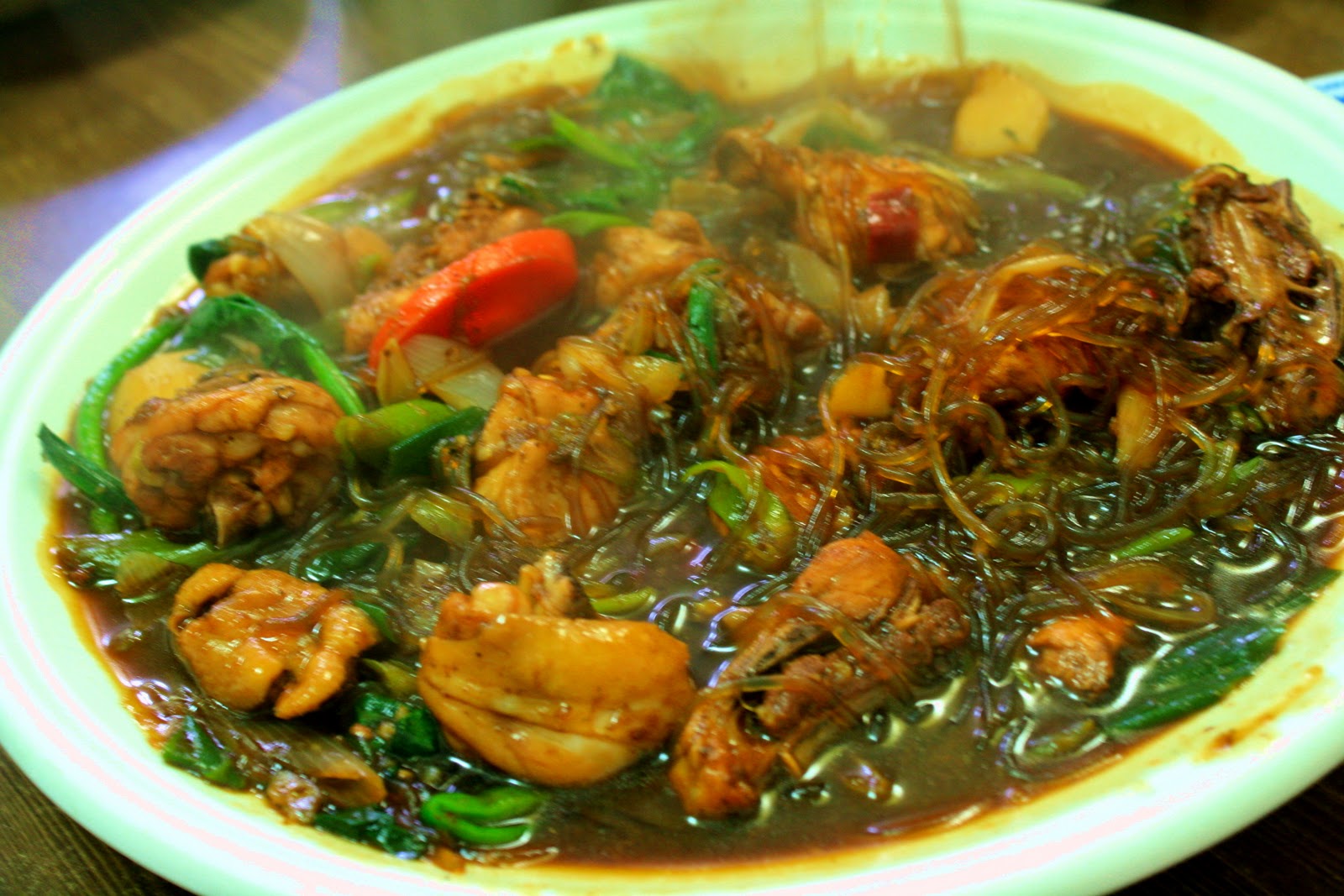
After cabbing our way back into the city proper, we sought out Andong's arguably most celebrated cultural property: andong jjimdalk. This is like a bona fide stew, just with chicken rather than roast. Big discs of potato and carrot give it that hearty, home-cooked feel. The stew part itself gets reduced down to a thick, soy-based gravy, and it's kicked up a notch with the addition of red pepper. All this is heaped onto a bed of vermicelli noodles. The chicken really takes a back seat when it's all said and done.


There's no need to go into detail, but the legendary 40% alcohol content soju of Andong (which is rumored to not have been allowed outside of the city's walls) got the lion's share of the rest of the evening. In the grog of Sunday morning, the group rehashed what was yet to be done before heading back up into Seoul for another week of grind. It was clear that Hahoe needed to be seen.

Hahoe is the largest folk village in Korea out of which people still live their daily lives. Just a few kilometers west of Andong city center, it consists of several dozen houses, a ferry, restaurants, and a museum. Before we wandered through the village, we stopped for lunch. The menu: "phantom religious service rice." This is a horrible translation for a delicious appropriation of ceremonial food to everyday life. In the past, this food was part of ceremonies which were held to remember and respect lost loved ones. Nowadays, this spread of grilled fish, salted mackerel, piles of side dishes, and a local variation on bibimbap is less about veneration of one's ancestors and more about keeping those who've survived them full and happy. My stomach is okay with that.


We left the would be funereal commemoration and wandered into Hahoe village proper. It was not structurally much different from anything else I'd seen. The life of the place was what made it interesting. Something that's usually an outdoor exhibit was alive and operating. Vegetables hung drying along the typically barren walls of the homes, and wooden chairs sat in what I'd only known until then to be dust lawns. Here there was not only grass, but trees, garden stone paths, and even residence numbers for the postman.

One of the last things we experienced on the way back toward the bus station was the mask museum. Apart from hundreds of international masks, it houses 9 of the 12 original wooden masks that proliferate the touristy areas of Seoul. One of these is missing its jaw piece. The story goes that the man who was commissioned to carve these masks in the first place was told to do so under conditions of the utmost secrecy. Obediently, he wrapped his house in paper and sequestered himself for the duration of his task. Unable to control her curiosity, a young girl from town poked a hole in the paper with her finger and took a peek. Although he was on the 12th masks mouthpiece, he hadn't finished the task yet, and as the girl peered into the room the carver promptly died. 4 of these originals have been lost or damaged over the centuries, but 75% of the history remains there in Andong.

The question that persisted through the weekend: Are you Andong? Final decision is yes. I could eat jjimdalk on the regular. I was impressed with the concentrated history. I want to see the various folk festivals of the summer. I enjoy being ensconced in mountains. I felt at ease in the laid back environment of both its people and its foreigner community. I am totally Andong.