Pages

Monday, November 29, 2010

YeongPyeong Island

As usually happens whenever the North does something wonky, there's been a wave of concern from people stateside about the well being of people living in Seoul, namely myself, were war to break out on the Korean peninsula.

In case you've missed it, the North fired live artillery shells onto an island off the east coast of South Korean shores in what may be considered disputed waters.  The incident left four dead, including two civilians.

On our side of the DMZ, reaction has been mixed.  It's true that the civilian deaths have sparked some contained outrage here in the city, but the overall response has been to criticize President Lee MyeongBak's failure to act more swiftly and forcefully.  In my opinion, the Korean people would rip him to shreds no matter what reaction he had; he's not a very well liked president.  In any event, the administration sacked the Minister of Defense.  There has been little activity since the first bombing save some ramp up of defenses on the island and the typical squabbling over who provoked who.  Aside from that, everything has been business as usual, with the local media and civilian population going back about their lives as if nothing has happened.  If there's anything the nuclear tests in 2006 taught me, it's to worry when the locals do.  If that philosophy holds true, then all's well.

I'd like to recount a story I read in a local newspaper on Saturday.  According to the paper, the U.S. General in charge of forces in Korea visited the scene of the bombing to survey the damage.  Shortly after his departure, the North began firing artillery again, but this time into their own waters.  This behavior says two things to me about the North's mentality.  The first is that they know they've rattled some cages and they want to let the South (or perhaps even their own citizens) know that they're the ones in control.  The second is that they're too timid to stick their tongue out while the parents are watching.  That is to say, when the States are on the scene, they can behave themselves.  When we've got our backs turned, the North Koreans start teasing again.

Given that there's an evident fear to provoke the U.S., I highly doubt that we'll see another incident until the media turmoil tires of the uneventful.  If this is truly a solidification of strength to pass power to Kim JeongEun, then  we can be sure to see at least a few more hawkish moves on the part of the North, but contrary to popular belief there's nothing crazy about Kim JongIl.  He's calculating and he knows how to keep his power.  If he appears weak to his people, he loses the underpinning of his cult following: the deception that he could topple the U.S. at any time.  He must keep poking the tiger without ever waking it up, because then he knows he doesn't stand a chance.  So far, he and his father have gone almost 60 years without losing it all.  Kim JongIl's more than aware that there won't be anything for his son to take over if he oversteps the boundaries while trying to pass the torch.

My final word would be to not believe the hype about riots in the city, devastation on YeongPyeong island, or the brink of war for the region.  The panic stateside wasn't half as bad in March when the North allegedly sank the Cheonan, resulting in 46 casualties.  Sometimes the things American media chooses to run with can be as arbitrary as a slow news week.

To Taipei

In my swiftly becoming tradition of buying the cheapest plane ticket the night before a break, I recently made the snap decision to fly to Taiwan for 5 days. Hereafter is the chronicle of the sights and smells of the little island off the coast of China.


This is not the ticket,
but rather a subway token.
Day 1
With its airport well outside of the capital city of Taipei, it takes a little over an hour before I really feel like I am in a different country. The people are still short and sporting unanimously black hair, and the existence of Chinese on signs is not so abnormal in Korea. My first clue, however, has to be the weather. I hadn't realized just how close in latitude the island was to Hong Kong, but it has the same balmy sort of tropical thickness. Stepping out of the airport and waiting for the bus is like spending a half hour in the sauna. My recently shaved head is going to get so burnt!

Shortly after arriving in the city proper with my travel buddy from work Josh, we start to scour the streets for food. Suitcases in tow, we cram into a little place with a lot of business. There seems to be little more than one thing on the menu, so we order that. Already a marked difference between Taiwanese and Korean food. This particular dish is a noodle soup, the broth of which was as viscous as Double Dare slime, though admittedly more appetizing. The what-seemed-to-be-pork and oysters was definitely an odd surf and turf meat option that I hadn't expected, but over all a nice kick off to the week of food that is to come.

The hostel's common area,
which surprised us by
just being some guy's house
After our lunch, we wander around and survey the hostels available to us while slurping down one of the many bubble teas we would drink throughout the week. Finally, we settled on a quaint place sandwiched between a bakery and a cosmetics shop. The narrow staircase to W Hostel climber up into what was certainly this man's home. (We never determined with any certainty the name of the hostel owner, but for the sake of story telling let's call him Willie.) After dropping our bags and settling our bill, it was back out into the street for some exploring.


We wander around the area we are staying in, known as Zhongxiao Fuxing on account of it being the intersection of Zhongziao and Fuxing roads.  This eventually leads us all the way down to Longshan Temple, which was seconds from closing when we arrived, and the Ximen night market.  Unfortunately, all I can say is I stood outside of a stall that serves snake.  The story is a far cry less cool than it could be, but the sight of it was stomach turning.  I haven't wimped out on a food adventure yet this year, so I think you've gotta give me this one.


Day 2
That white outline you can barely make out amid the danger pink?  That's Taiwan.
Our day starts with live footage of a sink blowing down the street during what will turn out to be, in regions south and east of the capital, devastating typhoon Fanapi.  A ponchoed female reporter screams while huddled in the fetal position behind a concrete column.  A delivery truck is toppled.  Breakfast of toast and tea.  Death toll at 10 a.m.?  One elderly woman who was trying desperately to do some last minute vegetable harvesting and two middle school students: a girl who slipped down the muddy banks into a flooded river and the boy who jumped in after her.
Rattled but not to be dissuaded on the first day of our adventure, we headed over to the original Din Tai Fung, a phenomenal 6-story dumpling and dimsum extravaganza.  Rain is off and on throughout our walk there, which is down the "runway" of sorts that leads up to the 2nd tallest building in the world: the Taipei 101.  It doesn't appear to be shaken, though the city might be.  With streets empty and the newspaper headlines ominous, we felt quite intrepid about being on the move.  The restaurant was relaxingly crowded, though, and leaving meant parting the sea of eager diners-to-be.
On the way back from brunch, we circled back through the Da'an Forest Park, then wandered down to the base of the 101 (If you haven't picked up on it yet, wandering is to be a real theme of this excursion).  The wind is really picking up by this time.  Cue the video:

Gusty and intense, you could actually at times lean 45 degrees into the wind.
A typical casualty on the streets of Taipei for the next few days.
The meandering continues as we find ourselves at the "Living Mall," which seemed like a suitable enough refuge from the wind. "Lots of shoes" and "a very confusing structure" are the memories I take away from this building that resembles a space station from Star Wars. Our impromptu walking tour of the city continues down Tea Street, or what we assume is Tea Street. There are a few tea shops, though nothing to warrant the name.

Perhaps this is as good a moment as ever to mention the bubble tea. We each drank 1-2 glasses of this a day. It's a cup filled half way with tapioca balls, half with ice cubes, then finally topped up with (typically) sweetened milk tea. I'm no stranger to bubble tea, but this is a whole new ball game. The tapioca is fresh, plentiful, and addictive. Since this trip it has been a recurring craving of mine.

We finish the day off with a series of foods, starting with a deceptively simple bowl of rice with an egg. I don't know why it tasted so good. Maybe it was the sauce the soaked into the rice, maybe the veggies and nuts, or maybe the fish shavings even. One things for certain: that would be a staple of my diet were I a local. We moved on to a beef and onion calzone type dish, a plate of butter sauteed asparagus, and some spicy tofu dish. All expertly devoured. Don't drink the sweet black licorice jello beverage.


Day 3
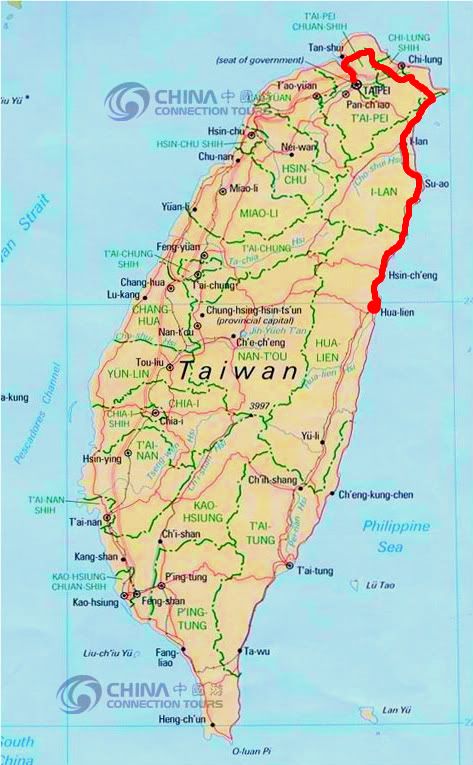
We decide late the night before to get out of the city.  To the astonishment of our hostel owner, we inform him of our quest to take a train to the Taroko Gorge and back in one day.  Against his advice to stay Hualien, we head out to the train station.  The worst of the typhoon has passed, with nothing left but fallen branches and some light rain.  We're not quite sure where to get off the train or how to find transport from the station to the gorge, but the ride itself is quite pleasant.
It's nice to see some smaller towns and farm fields, but there's also a prominent industrial presence. We pass multiple large factories on our way. The small towns are also a good vantage point from which to notice how strongly the temples jump out of the scenery. While the majority of the landscape is grey and brown, the temples were stark, unnatural reds, yellows, and blues.

The gorge itself is a 30 minute uphill walk through a small town. There is much more evidence of Fanapi's passing on this side of the island. By now its almost noon, so we stop at a fruit stand shortly after getting off the train. Lunch is the most amazing mango and dragonfruit I've ever tasted. Vibrant color, huge flavor. Nothing will ever compare again.

Taroko Gorge is the most impressive experience of the trip. The pictures sort of do it justice, but it is absolutely breath-taking. Towering, tree-packed mountains, with fog snaking over and between them, stand like walls on either side of a typhoon-flooded river. Waterfalls drizzle out from imperceptible sources throughout the range.
It also is the site of one of our most authentic meals on the island. A small group of monks in this monastery in the foothills is preparing food for themselves. Before we know what happened, we are ushered into the silent "cafeteria" on the third floor of this temple and aimed at the dishes. Without explanation or instruction, we are observed in a hushed silence. We eat our absolutely delicious vegetarian rice mix, noodles, moon cakes, fruit, and soup in the same silence. There's a feeling of calm in the air that discourages words for fear of breaking the peace. Naturally, photographing the scene would have felt obscene. We leave the temple slack jawed and wide eyed at the hospitality we've just encountered.

We arrive, exhausted, back in the city after dark. We get a quick meal of beef noodles, pork blood soup, and pickled cabbage noodles. The bubble tea of the day is with Pu'er tea, plum juice, and lemon.

It is at this point, with 3 days left, that my camera breaks. The remaining time is captured on Josh's camera and the story will continue when I get the visuals necessary to do it up right.

Monday, October 18, 2010

The Kimchi Crisis

Being a member of the inner city and not of the sky scraping suburbs, I have not personally seen much effect of the recent outrageous prices of kimchi, the most integral food to every meal of Korean cuisine. The long story short is that something to do with the weather this year has left a shortage of radish, garlic, and (most severely) cabbage in Korea. This has led the prices to soar and, despite government subsidies, the production of the dish this harvest season to decrease. Being that it's a fermented food and usually takes months if not years to make properly, I hadn't predicted much effect on the consumer side of the market for at least half a year. However, last week I was refused kimchi for the first time in a restaurant, with "high prices of cabbage" cited as the excuse. Jaw-dropping.  I had hoped to take part in some kimchi making this year.  We'll see if the festival still takes place.

Saturday, October 16, 2010

Top 4 Things that are Popular in Korea, but Never Could be in America (and Why)

Floor Sleeping:
Camping is great and all, but no one wants to do it everyday.  Sleeping on the floor is the norm here.  Just throw down a blanket and lay on it!  I can't see this ever catching on in America.  Even when they have a "bed," it's definitely fusion.  They will buy a mattress sized wooden box with a mini-headboard, then throw down a blanket and sleep on that.  I can't understand why they don't embrace the soft sleeping scenario, but perhaps it's a space thing.  Most of the Westernization happens through the younger generation, who either live with parents and therefore don't have a choice what they sleep on or live in a whole so small that the bed has to roll up to make the space work.

Octopus:
On a rare occasion, you can get a group of people together who can get stomach fried calamari from an Italian restaurant, provided it's thoroughly fried, devoid of texture or fish flavor, and accompanied with a bucket of sauce to douse it in.  In Korea, however, octopus and other seafoods are eaten far more often than chicken or even pork.  This culinary contradiction is a reflection of the nature of the two countries, in my opinion.  Whereas America is broad, with plenty of land for livestock, and a history of land-animal consumption, Korea can fit into America an almost even 98 times.  This combined with being a peninsula and a general Asian affinity towards foods from the sea, means octopus is the new beef.  I've eaten octopus steamed on a stick, dried, fried, grilled, sauced, over rice, in soup, and even alive.  It's gotten so bad that I walk through street food areas and have to convince myself that it doesn't smell good.  It doesn't, but that doesn't mean it can't be appetizing.  It took a long time to even reach this stage, where I not only don't notice but am sometimes in the mood for octopus, and it's another thing I don't see America embracing any time soon.

Wrist Grab:
I'm sitting in the office, preparing for class.  Suddenly, a hand comes from over my shoulder a grabs my wrist, with the clutch and unexpectedness of a zombie from the grave.  It's just my boss of course, but the wrist grab is just a way of getting attention in this culture, like a tap on the shoulder or a psst!  It doesn't stop at this one interaction, of course.  It is a move of endearment, friendship, even attraction.  It's not at all uncommon to see a boyfriend wrist grab his girl on the sidewalk, or watch it be used almost as a pick-up line.  To the Western wrist it feels extremely disrespectful in the office and aggressive in the bar, though I know it's not meant that way.  I'll stick to words, thanks.

Toilet Paper:
Obviously there's more to this.  Sure, we all use toilet paper for it's obvious function, but one way in which toilet paper will never be employed is as napkins.  Or paper towels.   Or on a restaurant table for customers.  There's just that bathroom connotation that, except for the odd bachelor pad, will never be socially acceptable in anything food-related.

Wednesday, October 06, 2010

Top 3 Things that are Popular in America, but Never Could be in Korea (and Why)

Tetris:
Though t may be mathematical and nerdy, Tetris can not reach a state of popularity in South Korea. The reason? The F word. That's right. You know how one of the Tetris pieces looks like an amputated medical cross?  Well, Koreans believe that looks strikingly similar to a representation of the middle finger, and have endearingly titled the gesture "f*** you."  Turn your back on a class full of rascals for 1 second and it is sure to happen: one student will shoot the bird at another, and that student will immediately shout, "Teacher!  He did f*** you to me." Of course, he will simultaneously demonstrate the offensive gesture in your direction while tattling, thereby compound the annoyance of the tattle with actually cursing and flicking off the teacher.  Back to tetris, this particular piece can be found scrawled all over the desks and walls of the schools.  A game based around it would be too much for them to handle.

Salsa:
A delicious condiment for chips, salad, or anything in a tortilla, we all know that salsa can range from sweet to extremely spicy.  While these are flavors that Koreans know and love, especially pepper based spice, I don't believe that this dip will ever find popularity without a name change.  This is because the word salsa is terribly close to the word sulsa, meaning diarrhea.  There is literally no way to pronounce salsa without garnering a cringe (or in the case of elementary students, an outburst of laughter), even if you enunciate with extreme precision.  If you walked into a foreign restaurant and there on the appetizer list was something dubbed "dee-a-ree-a," would you take the chance?

Drive Thru:
One of the qualifications of a true "fast-food" restaurant is the ability to purchase it without the extra hassle of parking and walking into the store.  The convention of the drive thru is so omnipresent that it may be hard to imagine a world without it, and yet it does not exist in Korea.  Yes, we have McDonald's and Burger King, KFC, Popeye's, even a Taco Bell now.  Not a single one of them offers drive thru pick up.  This is a combination of space problems and market needs.  For starters, the drive thru requires a wide swath of private road around the fast-food restaurant in question.  However, most of these establishments are on the first floor of a 12 story building that is crammed next to a whole row of 12 story buildings.  In a city that stacks everything from grocery stores to movie theaters, there just isn't the spatial luxury to pave a moat around your burger joint.  Of course, we also have to consider that the operative word in drive thru is drive.  In a city with a popular subway and bus system, not to mention a thriving pedestrian culture, a drive-up window would only be convenient to the smaller segment of the population that is actually driving their cars.  To counter act these space and market constrictions, fast-food joints have begun to offer walk-up window service or even delivery.

Thursday, September 23, 2010

Tourism Time

With the combination of friends in town and new teachers to break in, I've had the chance to be a tourist in my own city again this past month. Most notably, this has manifested as a trip to the zoo and one to the War Memorial.

There are some weird things about an Asian zoo, but not many. I did feel a little too close to the animals, but never in an unsafe way. The exhibit of the Americas made me feel a little strange. The exoticism of what seems so ordinary in America puts into perspective just how far away I actually am. However, after multiple cages of wild dogs I can't take your zoo seriously anymore. Coyotes? Not zoo worthy. Racoons and possums? I've hit more with my car than your zoo can afford to import.


The War Memorial is a museum that I've always intended to go to but never gotten around to it. Although it contains them most comprehensive exhibit on the Korean War, it is situated near the army base in Itaewon rather than near the DMZ itself. Probably the most interesting feature was the extensive collection of air, land, and sea vehicles on the lawn, not to mention missiles and other large weapons. Both the outside and the inside of the building were adorned with various commemorative statues. There are two open-air wings of the museum dedicated strictly to the names of the countless soldiers who served during the war. The museum also goes to great lengths to recognize each and every one of the countries who helped secure South Korean independence, complete with videos of each nation's specific contributions to the cause. More than just a recount of the important battles, it was a very somber place, truly earning it the title of War Memorial.

Hokkaido

For my summer vacation, Hokkaido happened.  Hokkaido is the northernmost of the main islands in the Japanese archipelago, and it lived up to it's reputation amongst the Japanese people as the place to go for food.

For starters, I was lucky enough to go on this trip with a friend from college.  Thanks C.H. for coming all the way out to Korea!  When we arrived in Sapporo (like the beer), we didn't know any Japanese and we didn't have a place to stay.  Although Hokkaido is a very popular summer destination for travelers due to its temperate climate, we were fortunate to find it not too crowded.  We also soon realized that its popularity with tourists was in fact with nationals.  This fact became evident when not even our hotel spoke any English.


Inside of the city, there were several things to see, including a giant Panasonic clock styled like the Tokyo Tower and, of course, the Sapporo brewery.  We also toured a local sake factory.  The process is complicated!  We went to another old brewery that was converted into a mall, and we saw the Museum of Literature just off of Nakajima Park.

The city had a rich history, but lets be straight: this was a vacation for food.  Accordingly, as I prefer on my trips, there was non-stop eating.  Sushi all the time, some of the best shrimp I've ever had, crab legs, barbecue, grilled squid, okonomiyaki, street food, and mochi.  The pictures speak for themselves.

One of the best decisions we made was to take the train out of Sapporo and into the harbor town of Otaru.  From there, we took a ferry out and around the cape into a small town called Shukutsu.  It was a fantastic peek into the local culture (and flavor) of Hokkaido.  I want to live in this town when I'm old, fishing for squid and watching the fog roll in over the forest blanketed mountains.


Overall, a totally awesome summer break.  I think C had a great time in Korea too!  Open invitation to anyone who can get a ticket, as always...

Saturday, August 28, 2010

The World Must Know the Truth

I have seen, done, and eaten some very strange things in my time here, but this is intolerably weird.  I ordered a Hawaiian pizza.  They put ham on it, and then instead of pineapple they decided to scatter the contents of a 4th grader's lunch box fruit cup on top.  Maraschino cherries and all.  Most disappointing pizza of my life.

Saturday, August 07, 2010

World Cup Infiltrates the Classroom

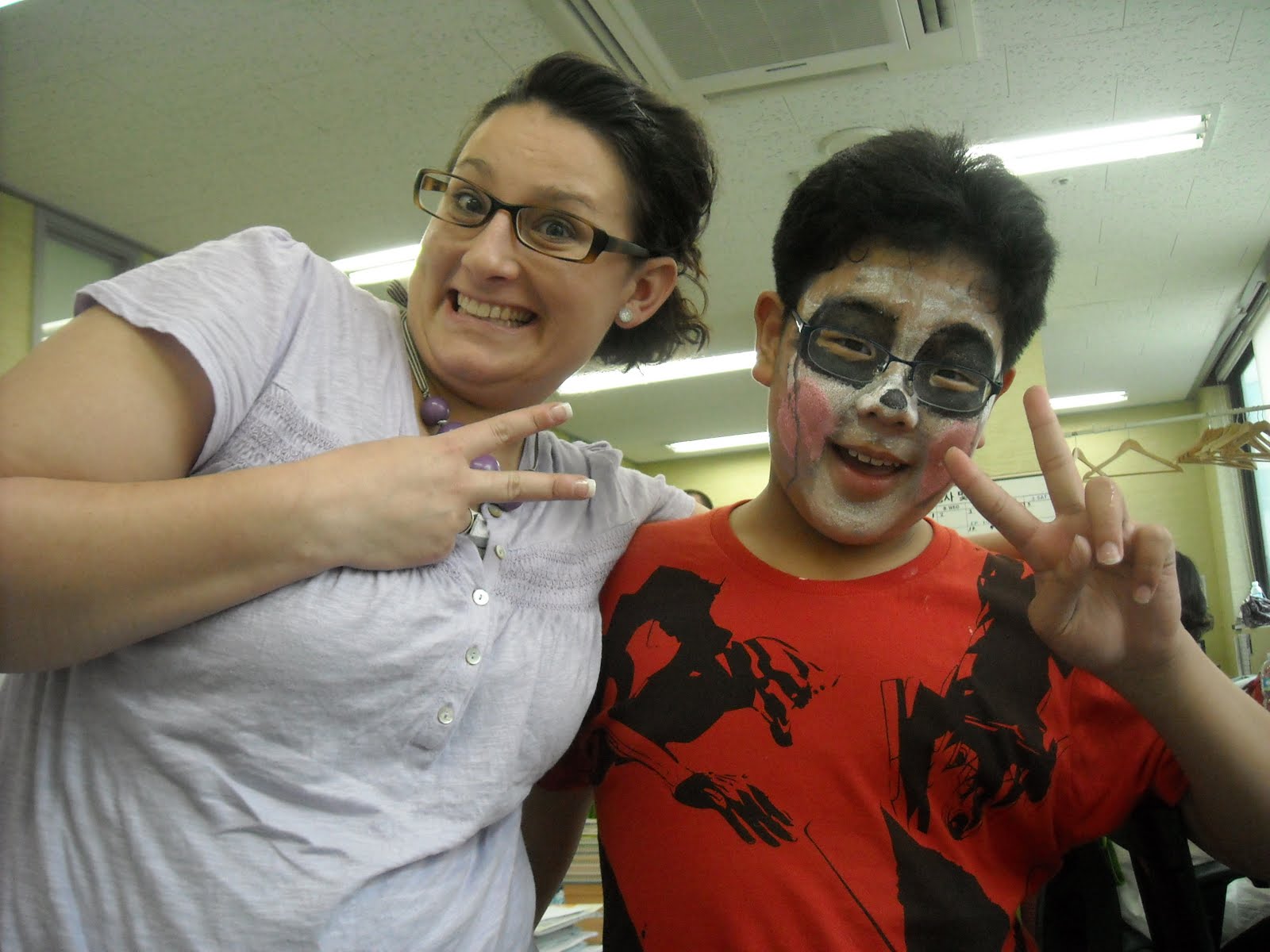
Just found this on my camera when I was going through Hokkaido pictures (post inc).  Derek had promised his public school teacher he wouldn't erase that face paint mess until after the game that night at 3.  If Korea had won, he was going to shave all of his hair.

Tuesday, May 25, 2010

K-pop

Being that I teach primarily 4th-6th graders, I'm constantly inundated with and benefited by knowing a little something about the Korean popular music (K-pop) scene. I've also been here long enough to start seeing a shift in trends and an emergence of something new.

Korean music has, for as long as I've witnessed it, been characterized by excessive cuteness and feelings. As a whole, there is nothing in the mainstream outside of love ballads and dance music. Even the dance music has always been lyrically identical to the ballads, with only the addition of a Backstreet Boys style collective dance to go along with the beat. The whole "scene" is fairly shallow and unoriginal, to speak plainly (not to say that the American pop scene is any different, but just to characterize).

Lately, however, I have seen a shift in Korean music that has been noteworthy. There are three parts to this change. The first step was 2NE1. Whereas for ten years, the artists have dressed similarly and safely, 2NE1 brought a whole new style to the table. Since their introduction of vertical hair and outrageous outfits, the entire music industry has followed closely behind. Half the time they look like George of the Jungle should have watched out for that 5th Element. The pictures speak for themselves.


Debuting early last year, 2NE1 is certainly no longer a latest development. However, I think that their advent paved the wave for what was to come. What started as simply different clothes and attitude soon spread into the lyrical aspect of K-pop.  In the past several months there's been a shift from the typical, ballad style lyrics to a new format.  Korea, for some time now having been dominated by the girl group, has constantly been plagued with the same song to a different tune.  Either "omg I like him soooooo much.  what should I do?  my heart won't stop beating!" or "we broke up!  there's no one in my heart but you!  even now I can't stop thinking about you!" (sadly, the format barely differs when guy groups perform).  Lately, however, I've witnessed the emergence a new trend toward songs about women standing up for themselves, much in the style of Beyonce.  The prime examples of this would be the nearly simultaneous releases by groups SNSD, Kara, and now Lee Hyori, all of which saw the once cute-to-the-max take on a role with more independence, maturity, and substance.


This week I've seen what I hope to be the next step. Fairly new group f(x) releases their song NU ABO with positive reception. Blood type in Korea acts as a substitute for zodiac signs, predicting a person's personality and relationship compatibility. In 4 varieties, this uber-homogeneous society has summed up all personality possibilities. Finally, f(x) steps up to the plate and questions this "ABO" system, claiming that they are not A, AB, B, or O but in fact an entirely "Nu" blood type. In a country where sharing and following is a powerful cultural status quo, a dominant pop group is directly challenging the uniformity. High five to these girls for doing something original in K-pop (gasp!), though in my eyes they may just be a vessel for the build up I've been witnessing off and on for almost 5 years.


In completely related and yet still unrelated news, apparently the President has decided to use K-pop group 4minute as broadcast propaganda to the North?

Friday, May 21, 2010

International

Let's pretend I've opened a fancy coffee shop in a trendy area of town. I give it a mysterious and undecipherable name like, say, Coffee Break: Season 1. Then I set about decorating. It's very modern, all white and black. I'm a cutting edge coffee shop owner, you see. I don't want a cozy nook for Yeats fans. Oh no. I'm creating a cool hang out for the urban youth of a globalized city, one that they will frequent with the same regularity with which they view their television shows. I know my audience: they like an international atmosphere. One way to achieve this is through clocks on the wall with times from the major cities of the world. Something that draws the coffee-sippers mind to other modern and fast paced locales that I'm surely associated and familiar with.

The problem: only one of the cities I have chosen can anyone recognize as a legitimate city, much less an urban hub.

From left: Thimbu, Yerevan, Santiago, Praha, Accra

I know that "Praha" is how the Koreans pronounce and thus anglicize "Prague," and Accra is a city somewhere in Western Africa, but Thimbu is flat out made up.

***Thanks to some fast response from followers, we have a complete list of the 5 cities whose times coffee drinkers need to be aware of: Thimbu, Bhutan; Yerevan, Armenia; Santiago, Chile; Prague, Czech Republic; Accra, Ghana***

Tteokbokki

They say this is the next big push in the "Korean Culture Wave" or hallyu: Korean food to the world! I tried to make this particular dish at home today, and it was a delicious success.


Spicy, chewy tteokbokki is made with pieces of "tteok," which is basically rice that's been compacted into thick noodles. Korean mac'n'cheese?

Tuesday, May 11, 2010

Kim Yuna

Perhaps I missed the international blog wave by a few months, but this chronicle would be incomplete without an entry about Yuna Kim (henceforth to be referred to in the order I'm used to: Kim Yuna).

For the vast majority of Americans, Kim Yuna is a name we can't recognize, much less identify. She is the 19 year-old Korean girl who won gold in the Vancouver Winter Olympics, beating out her only slightly more well-known Japanese rival Mao Asada.

Kim Yuna (center) with Asada Mao (right) and some white chick

Kim is a national celebrity here like nothing I've ever seen.  Seoul is an extremely wired city, and gadgets are the name of the game.  More so than in the states, TV on the cell phone has really taken root here.  I happened to be out and about on the day that Kim Yuna was skating for the gold.  I saw cars pull over in the already unusually empty streets to watch the action on their cell phones.  Coffee shop employees had laptop wires running across the espresso machines: coffee stopped for the viewing of this program.  Bus drivers, while still keeping on their route, refused to be the only ones on the bus not watching a cell phone.  People clustered around TVs in windows, and everyone stopped talking.  The third largest city in the world literally stood still for 6 minutes of figure skating.


Some of the commercials featuring Kim Yuna

The popularity of Kim Yuna is twofold.  First, there's the enormous weight of being a country's sole representative to the international world.  Among Korean people, there are only maybe 4 who have achieved any measure of notoriety outside the peninsula.  UN Secretary General Ban Ki-mun, Manchester United team member Park Ji-Sung, and Korean pop star Rain (who has been part of a mock rivalry with comedy talk show host Stephen Colbert as well as star of several bad Hollywood movies) are the only other South Koreans that any one in the West has any real chance of knowing.  Aside from that, Korea is always burdened with its negative association to Kim Jung-Il as well as hidden in the cultural and economic shadow of its number one rival Japan.  Kim Yuna not only beat Mao Asada but also brings international attention to Korea, and therefore is practically royalty.

The other side of Kim's appeal is her personality.  In a country where some of the biggest stars have been cast aside because they became recognized for bragging, bad-mouthing, or womanizing, Kim Yuna has managed to charm the nation with her innocence and humility.  She is very respectful to the people who have helped her get this far and seems to disbelieve the success she's gotten.  She has tasteful and conservative outfits, and her "signature" 007 move has swept the nation.  The cynical American in me is quick to jump to the conclusion that she's just another pretty face, but Koreans will readily tell you that they don't think Kim Yuna is pretty at all.  "Her eyes are much smaller than Mao Asada's."


In her short lifespan, she's managed to not only win medals and set records, but also land some of the most sought after advertising spots. In Korea, there are not many people whose faces you'll see more often than Kim Yuna's. There's a permanent advertising slot left open for the hottest girl and boy groups of the moment, but nothing comes close to the mountain of sponsors heaped on this girl. She's the Korean face of Nike, top cell phone provider Anycall, Hyundai motors, Hausen air conditioners, Smoothie King, numerous makeup products, Samsung, school uniform company Ivy Club, those softening dryer sheet things, local bakery chain Tous Les Jours, a brand called Everyday Milk, Kookmin (citizens') Bank, and Whisper feminine products, to name what I can think of. You can basically see her everywhere you go, all of the time.

You can currently buy the Yuna "Be White" smoothie (not as racist as it sounds), the pink Yuna Haptic smart phone, or bite into the only bagel with a name branded on it. Can you think of another human in history who has been so idolized that their names were burnt into pastries?  Interesting fact about Kim Yuna: she's officially a student at Korea National University, though I can't imagine it's anything more than another advertisement.  How could she set foot on campus between the time constraints and the drooling fans?

Tuesday, April 13, 2010

Cherry Blossoms '10

It's almost spring again, and we set out on a weekend trip to see the cherry blossoms again (see last year's post).


We decided to make the trip a little differently than last year. No one had ever been to the East Sea (known to most of you by the fascist name 'Sea of Japan'), so we made out to the city of Gangneung. Gangneung is well known for having the largest beach on the east coast of the peninsula, and the province that it's in is famous for various potato dishes that you can't find in Seoul. We hopped an early bus out of the city and struck out eastward. The first stop was a farm for sheep raising. The weather hadn't let the grass come in fully yet (there was still snow and ice in some places! In April!!), but we had a fun time hiking around and feeding the stabled sheep. I know I must have seen sheep up close at some point in my life, but I don't remember them being so shaggy. I'm not sure whether or not these were being fed, but they were quite ravenous. It was cool that the baskets of grass were free! That stuff would've cost three bucks a pop in the states, but Korea hasn't quite figured out that you can gouge tourists/theme-parkers/movie-goers at every turn and we'll still pay for it.


The next stop was lunch, which sadly did not include any of the unique potato dishes. Due to our proximity to the ocean, there were several great places for fish. In the end, we opted for the region's home-raised beef barbecue. Hanwoo is the name for beef that hasn't been imported, and they take a great deal of pride in their cows. This would have been really expensive in the city, but we got a great deal. The main event turned out to be after lunch. The five of us rented a tandem bike for an hour and decided to take it around the lake. Actually, we decided to do a quarter of the lake and then turn around, but we made it all the way around in less than an hour! The thing looks like a golf cart, and 4 people pedal at any given time. There are two steering wheels, but only one of them has any control thankfully. Around the back half of the lake is a series of statuettes that told a historical story, but we were going counter-clockwise around the lake, so the story would have been backwards (if we had known that it was a story at all). This was the whitest, most touristy moment I've had in Korea in a long time. We were a spectacle. All five of us had cameras out and were snapping pictures frantically. It was a Saturday afternoon and the lake path was filled with Korean families, couples, children, and other tour groups (the most notable of which were 30-odd college students all wearing the same white hoodie that said "LAKESIDE FLORIODAS" across the front). To everyone whom we passed, we yelled "안녕하세요!" (Hello, how are you?) excitedly. I attempted to high five some of the other families on tandem bikes (as pictured below), with one success and one recoil. There was a girl who could not have been more than four years old who would have dropped her ice cream had she been holding one. She was terrified and slack jawed, and probably cried after we left without understanding why. Nonetheless, people who were older than her had said hello, so with her wide eyes and open mouth should reflex bowed like a good Korean child. All in all, it was a total blast, even if we disturbed the peaceful lake-side walk of the locals. When it was over, we could barely walk. We had been pedaling so furiously since at what seemed to be halfway we came to the realization that we had to do the whole thing, but we had a bus to catch! We arrived in plenty of time though, and it was onward to our next destination.


"High five!"


Our last stop was a strawberry farm. We showed up and it all seemed really ghetto. There hadn't been much rain, the weather was cold, and the fields were not much to look at. However, after stepping inside the greenhouse structures we realized that it was a really nice operation. There was a short lecture (in Korean) about the strawberries, how they were grown, and the proper way to pick them. We then got a chance to fill up a paper cup with fresh picked strawberries that also turned out to be organic. Without the chemical fertilizers or pesticides to worry about, we were allowed to eat them on the spot. The farm then gave us a packet of strawberries each to take home. Sunday morning: organic (practically) hand-picked, (practically) beach-side strawberries.

What was intended to be a trip to see the cherry blossoms on the beach turned out to be a trip to pick strawberries and feed sheep near a lake. but we had a great time anyways!

Holy Crap When?

Costco

Many months ago I made one of the most important decisions any expat must make.  The location of his unofficial embassy.  It's not a decision that one can simply make, however.  There are many factors, almost to the point of a mutual choosing of one another.  For me, the bond was made with Costco.

Costco represents everything about America that can't be accessed anywhere outside its walls.  Bulk discounts, most notably.  If I buy a whole box of juice bottles as opposed to a juice bottle per day, the unit cost is identical!  Logical but infuriating.  Costco spares me that furor by once again restoring the natural order of things.  Spending more money is the only way to save it.

Married to this idea is also that of excess.  Sure, I may never use 100 packets of instant oatmeal without developing either an aversion or a digestive problem, but no other option is presented.  You buy the whole salmon or you go home empty handed.  Costco is perpetually super-sized, and I derive sick pleasure from enveloping myself in the security of such excess.


I can not overlook the comfortable familiarity of brand recognition either.  Be it Head & Shoulders, George Foreman, Swiss Miss, or straight up Kirkland, Costco offers all the props necessary for recreating the authentic illusion of home.  It also offers me my most coveted food item: cheese, the subject of many a nostalgic blog post to date.  Not just pre-sliced, individually wrapped "cheese," but blocks of cheese in cheddar or jack, tubs of feta, wheels of brie, even little sacks of La Vache Qui Rit whole milk mozzarella are available to the man willing to cough up the won.  Coupled with this cheese is a variety of breads.  Wheat, bagel, croissant, muffin: it's everything I could ever hope for.

Lastly, Costco's food court is identical to that of any Costco I've ever been in.  The pizza is greasy, the hot dogs are cheap.  Even Koreans will tell you that this is the best part about Costco, but of course they manage to confuse their priorities even in this.  Every single Korean at the food court, without exception, makes a kimchi-substitute side dish to go with their food.  They grind a fresh plate full of raw onions, squeeze out a package of relish, juice it all up with copious amounts of ketchup and mustard, and stir.  This condiment "salad" is to be enjoyed with a spoon.  Although it looks like vomit, I refuse to allow it to ruin my experience.  However, I can't quite understand how an entire nation could be so crazy for spoonfuls of ketchup and raw onion.

Tuesday, April 06, 2010

My Hobby: Naming

Over the past year, I've had the unique opportunity to name children. Most people only get that opportunity 2-3 times in their life, but I'm here with hundreds of Minhyeoks and Jiyoungs and they all need names.

The benefit of this kind of freedom is the opportunity to make mistakes. Whereas I would never name my own child Phineas or Dexter, here I have the opportunity to test drive without having to buy.

The obsession stems partly from the fact that all of the students who choose their own names select the same, tawdry names that end in -y. Harry, Jenny, Tommy, Julie, Sally, Christie, and Ellie. Then there's the just bland names like Bill, Ryan, Eric, Chris, Sarah, and Grace (which gets particularly old because the Korean word for grace is a popular name here so they all just translate it).

Most annoying of all is June. In every class there is at least one June/Jun/Joon. The difference is that this child is exclusively male. Since many male Korean names include the syllable joon and they all know that June is an existing English name, they take the easy road. Surprisingly, no one has ever explained to them that June is, like all names from months, seasons, or plants, reserved for women.

It is expressly because of the Junes that I've adopted my interesting names hobby, though it may have started as a cruel joke. One of the things that is pretty consistent across the Junes (as well as other students who refuse to choose an English name) is that their resistance, laziness, and apathy usually extends further than just their lack of name choice. Often times these students become the problems of the classroom. As a type of passive-aggressive rebellion, I began naming these imps with English names that other children didn't have because Koreans find them difficult to pronounce. Valerie and Charles, for example, have both l and r juxtaposed, which Koreans find next to impossible.

The practice soon spread, however, and became an intra-office competition to give students the most outlandish names. From this period Tank and Blackhole were born. Finally we come to rest at the current situation. Select members of the office have joined my crusade to rid the school of Junes and increase the variety of names among students. Having come from a country where I'm used to international classrooms and jobs, I'm tired of the seas of identically named students. I miss going to school with Alfredo and Sauna, working with Juanito and Magno. We're starting more humbly (Douglas, Eve, Felicia, and Clive to date), but I've got a list and I'm passing out more original names.

If you have suggestions for a child's name, just add a comment. Think of it as adopting an African child but without the dollar a month. I'll even send you a picture of the child with your name.

Friday, April 02, 2010

Girl Scouts

I just want to say that while all of you people are buying your Thin Mints and gorging on Samosas, I'm in Korea where there are Girls Scouts but they don't sell any cookies.  What is even the point.  Now I have to look at my students in their taunting little uniforms and be constantly reminded how much I want to drop 30 dollars on a week's supply of Tagalongs but I don't even have the opportunity.  On the bright side there's always barbecue...